Can a generalist defuse a bomb?

Have you ever thought you could defuse a bomb in 7.3 seconds? Have you ever wondered if you could undo handcuffs with a bobby pin and break out of an isolated cell, beating down a dozen well-armed men? Those are specialized skills developed by super spies who have dedicated their lives to the pursuit of espionage. And they are also fabricated in the movies.

But back in reality, we are left to wonder what variety of super skills can one person develop over a lifetime.

To explore what it takes to develop diverse skills, we start with the Wikipedia article about Jack of All Trades. There is an implied dispute about whether it’s good to be a jack of all trades, as people forget the latter part to the expression which delivers the insult, “jack of all trades, master of none.” Interestingly, in Japanese, the expression is “many talents is no talent.” In Russian, one expression is “specialist in wide range” which can be a compliment or an insult depending on the level of irony. In Dutch, the phrase is “12 trades, 13 accidents.” It’s a fun read if you like insults.

But that’s just folklore.  Maybe we should seek some actual evidence on this topic?

Elite Athletes Provide the Data About Specialization

There is a custom that the title of “World’s Greatest Athlete” goes to the reigning gold-medal champion of the decathlon. Decathlon involves 10 track-and-field activities with varied measurements such as sprint-time and throwing distance. They can’t add raw scores, so decathlon has a points system that measures excellence and gives equal weight to each activity. 

Decathlon points provide an opportunity to compare the performance of decathlete generalists to the gold-medal specialists in each activity.

Usain Bolt posted the world record in the 100-metre dash – at 9.58 seconds – for which he would be assigned 1,202 decathlon points. The “decathlon best” or best performance by a decathlete is for Damian Warner who did that run in 10.15 seconds, for which he was assigned 1,059 points. Bolt’s performance is six per cent better than Damian Warner’s. But Warner also holds the decathlon best for 110m hurdles and won Olympic bronze for hurdles in 2016. Given the acceleration and deceleration required for hurdles, there is a prevailing view that Bolt could not win a medal at hurdles. 

Would you rather be the best in the world at sprinting, or the best of the generalists in multiple sports?

Under the current decathlon scoring system, a 10-person team of world-record holders of each sport could get 12,568 points combined, which is 16% stronger than the 10-person team made of decathlon bests. In elite sports, generalists function at 84% of the effectiveness of specialists. Specialists are better if exactly one skill is needed.  If you have the option of creating a team, a rag-tag band of specialist weirdos might give you that 16% bump you desperately need. The drama is in the exceptional teamwork.

Single-person efforts requiring many skills are best suited for a generalist.  Otherwise, a diverse team of specialists will tend to outperform.

But teams are not allowed in the decathlon. For single-person efforts demanding many skills you are better-off assigning a generalist like Damian Warner. Movie series like Indiana Jones, James Bond, and Jason Bourne are built around the idea that one person has all of those special skills that are needed to save the day, if not the world. But there’s something off about those movies. The hero’s sidekick is stereotyped as a less-capable younger woman who might become sexually available in the next two hours. That might not be a viable model for a respectful workplace, career navigation, and statutory compliance.

Mathematics in the Post-Soviet Era

But back to the math.  In an article in the Harvard Business Review researchers looked at changes in the research performance of mathematicians between 1980 and 2000. The Soviet Union, which had exceptional mathematicians, had a political collapse in the middle of this time period. Soviet mathematicians were set free and unleashed onto the world, disrupting mathematics globally. This change generated a natural experiment for research outcomes before and after the Soviet collapse. It was also possible to categorize mathematicians into those publishing in a single specialization (i.e. specialists) and those publishing in multiple fields (i.e. generalists).

Generalists are stronger in stable environments and specialists are stronger in environments of change

The research question was, what is the relative performance of specialists vs. generalists, in those fields that were stable relative to those that experienced disruption? In brief, they found that generalists are stronger in stable environments and specialists are stronger in environments of change. In those fields that were stable and evolving slowly, specialists under-perform generalists by 22%. The generalists were able to draw from diverse knowledge in the broader mathematics domain and accomplish more. In environments experiencing dramatic change, specialists outperform generalists by 83%. Those specialists were able to use the new knowledge that was at the frontier of their specialized field, pushing the boundaries far more.

These findings are specific to scientific creativity, not to be confused with other types of performance. We have no idea how mathematicians would lead a team of staff in a wet lab, in so far as mathematicians understand wet labs, or staff. Also, publications are elite performance. There are areas of good-enough performance where very basic knowledge is the most important thing that day, such as choosing to be rude to a potential assailant or getting someone who is suicidal to a therapist. There will always be a place in the world for some general knowledge.

How to Allocate Your 10,000 Hours

Malcolm Gladwell’s 2008 book Outliers asserted that it takes 10,000 hours of deliberate practice to master a particular skill. Gladwell simplified and popularized research by a man named K. Anders Eriksson, who had devoted much of his career to identifying how people become excellent. I read some of Eriksson’s work, and he didn’t actually proclaim a 10,000-hours magic number. It was an approximation. Eriksson was also describing what is required to become world-class at something done at the performance or tournament level, such as piano or chess. 

You’re still pretty good at 5,000 hours and you can become even better by putting in 20,000 hours.  For example, “Sully” Sullenberger had logged 20,000 hours of experience as a pilot before landing US Airways Flight 1549 in the Hudson River and saving 155 lives in the process.  (Thanks again Sully). 

In Outliers, Gladwell noted that you only have enough time and learning-juice in one life to completely master two fields, for a total of 20,000 hours of deliberate practice. Those trying for a third kind of mastery run out of time. If you need be really good at more than two things, you can’t really aim to be the world’s best. 

In my review of Emily Wapnick’s TED Talk, I summarized what you can do if you become restless in your career: Get into a new field every couple of years. Wapnick encourages those who have found their true calling to pursue that one thing. But for those who just can’t stay in one lane, there are ways to make a good life with what you have learned in multiple fields. There are unique, one-of-a-kind ways of advancing a combination of strengths.

Is it better to be a generalist or a specialist? The correct answer is to listen to yourself. You are the best at learning those things that are important to you. If the drive comes from inside, that is where you’ll find real motivation. And that motivation is the magic. If you look around, nobody is filming an action movie in which you have to establish yourself as the hero. You’re the only one who is always watching, so play to that audience.  Do your best, and do it for yourself.

Look at Her Go! Achieving the Perfect Quit

Sigrid practicing. By Victor Valore
Sigrid practicing.  Photo courtesy of Victor Valore.

This is a provocative article suggesting that it’s a good thing if an employer loses good people.  To be clear, it’s not a good thing if an employer loses people who quit in disgust.  Rather, if you are cultivating an engaged work environment in which everyone is encouraged to move onward and upward, then there is a price to pay.  That price is that sometimes employees take advantage of external opportunities.

The author of the article is Drew Falkman from a firm called Modus Create, a technology services company with a soft spot for people development.  He suggests that if you are losing good people it is a sign of an engaged work environment that attracts transparently ambitious people.  Ambitious people will regard your workplace as an exceptional diving board into the pool of life.  These can be good people to work with.

What do you think? Could your new employer brand be “diving boards are us”?  The reason I ask, is that most people are only familiar with what competitive diving looks like moments after the diver has taken flight.  But in the years prior to jumping the diver will have put much effort into developing courage, strength, and skill. Would you have a better workplace if a larger fraction of your employees were constantly building towards a visible and transparent goal?  This spirit of growing and striving would be a great workplace culture for employee and employer alike.

This change of attitude on the employer’s part redefines performance excellence as an act of motion amidst a growth mindset, not a final accomplishment that presumes a fixed state.  A workplace that is always striving performs better than one in which managers treat their best staff as collectibles.

Managers are notorious for trying to hold onto their top-performers and keep them at their current level.   It’s so convenient for the manager, having excellent people who are prohibited from seeking new opportunities, locked into place just-so, delivering double the productivity.  These people practically manage themselves, and the manager doesn’t need to spend extra hours training them or replacing them when they leave.  If the manager can cultivate a team like this, perhaps the manager could get the biggest bonus.

But thinking about the whole institution and the economy in general, locking-down high performers is a recipe for stagnation.  Perhaps the millennials were right?  Maybe we should stop tolerating mediocrity and take for granted that generalized career ambition is part-and-parcel of performance and workplace engagement.

Employers are increasingly desperate for good hires into the senior ranks, and they’re blunt that they should always be free to bring in good people from other institutions.  So, as a society, the “correct” opinion is that employers and employees alike should be moving everyone upward and onward.  Therefore, career-growth exits are a good thing.

But it gets better.

Falkman also suggests that former employees are valuable to your organization as well.  Former employees can speak highly of their work experience at your organization, improving the employer and customer brand.  Supportive former employees can also become committed customers, suppliers, or investors.  You can go the extra mile and organize this resource of boomerang employees, building current staff to eventually be part of an alumni pool who continue to grow, keep in touch with their peers, and make themselves available as boomerang employees.

Every now and then a contrary opinion comes along that you really need to take seriously.  This is one of the good ones.

[Repost from December 14, 2017]

Swearing makes people stronger

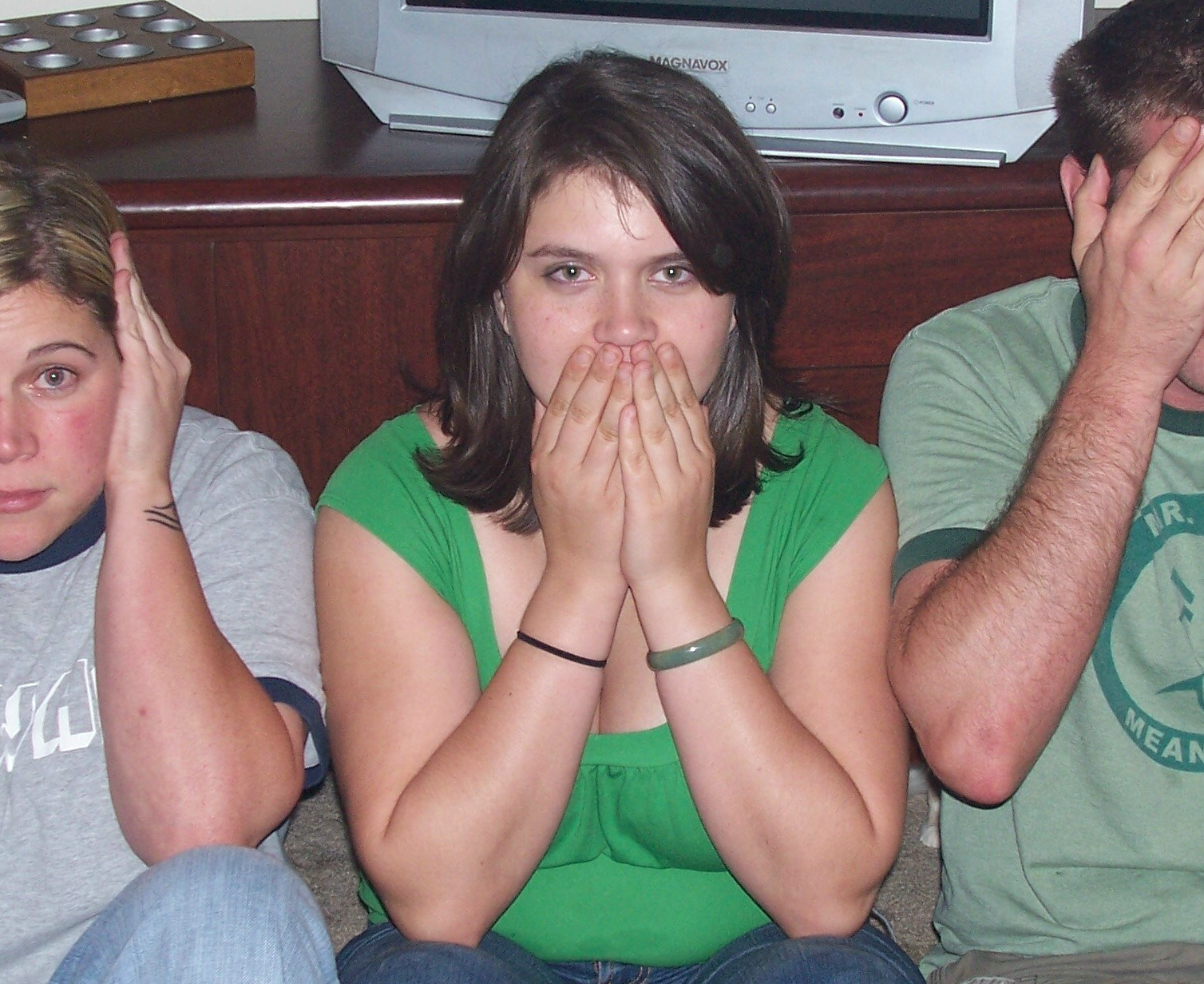
Hear no evil, speak no ev... Well you know the rest. By Barbara Burton
Hear no evil, speak no ev… Well you know the rest.  Photo courtesy of Barbara Burton.

Do you swear in the workplace?  I bet you try not to, at least not too often.  But sometimes it slips out, and sometimes it just feels right.  What do we know about the effect profanity has on our candor and our emotional closeness to others?

Years ago, I was driving my two-and-a-half year old daughter to childcare.  It was cold out, and she was safely bucked into the car seat in the back.  We lived on a major street, and I drove Westbound a half-mile to the nearest red light.  There was a car in front of us with the right turn signal on, but they weren’t turning.  My daughter said “Get out of the fawa way.”  My head tilted, and I ran the phrase through my head.  “Sweetie,” I asked, “what did you just say?”

“Get out of the fucking way,” she announced.  I contained my laughter.  This was her first F-bomb, and I had just enough self-control to realize I couldn’t teach her this was funny.  I had to keep this social.

“Darling,” I asked, “where did you learn to talk like that?”

“Mummy talks that way every time she drives.”  I gripped the wheel and tensed my facial muscles, using all of my life force to resist laughing.  The light changed, and we continued driving.  I turned into the ever-familiar cul-de-sac, and we stepped into the childcare to take off her shoes and jacket.  I asked our childcare provider, Liliana, if I could borrow her phone.  I said there was something I needed my wife to hear.  Liliana said she knew what this was about.  She was experienced.

I phoned my wife who was at home on maternity leave bonding with our second child.  “Hello?” she answered.  “Hi, your daughter just said something and I want you to hear it” I said.  “Oh, this can’t be good” she cringed.  I handed my daughter the phone and prompted her to “Say to mummy what you hear her say every time she drives.”  She was wearing a cute little dress with pink flowers.  She held the phone to her ear and yelled: “Fuckin’ mooove!”

What the Science Says About Profanity

What does swearing accomplish, really?  Citing excerpts from Emma Byrne’s Swearing is Good For You a Wired article from January 2018 described several behavioral experiments involving swearing.  In one, test subjects were asked to submerge their hands in ice water until they could not tolerate it any more.  Some were asked to state neutral terms describing furniture, and others were asked to say a profanity.

“…when they were swearing, the intrepid volunteers could keep their hands in the water nearly 50 percent longer as when they used their non-cursing, table-based adjectives. Not only that, while they were swearing the volunteers’ heart rates went up and their perception of pain went down. In other words, the volunteers experienced less pain while swearing.”

Enduring physical pain was also associated with aggressive game-playing, and a willingness to harm others in a simulation in which they could choose to shock others.  There’s a cross-over between insensitivity, enduring discomfort, mean-ness, and profanity.  Hence our vocabulary is so much richer when driving.

Swearing also makes people physically stronger.  Athletes can attest to this.  In one study cited by the Guardian people swearing while operating an exercise bike saw their peak power increase by 28 watts.  In another test, profanity increased grip strength by 2.1kg.

We can envision a profanity-rich working environment where people exert physical effort and occasionally get hurt.  I imagine construction sites, the armed forces, and resource sectors as places where swearing might just be a normal coping mechanism for the physical environment.  But what about an office environment?

Directly quoting Byrne’s book once again, an article from the Cut noted

“From the factory floor to the operating theatre, scientists have shown that teams who share a vulgar lexicon tend to work more effectively together, feel closer, and be more productive than those who don’t,” she writes. …A study published earlier this year backs up this and other research, suggesting swearing with colleagues can help create “a sense of belonging, mutual trust, group affiliation … and cohesion.”

Referencing other research, the article noted that profanity “…does still carry some social risk — it’s still a little bit taboo — so it imparts a feeling of trust in whomever you’re swearing with.”

Profanity Must Be Distributed Fairly

It’s interesting that we would trust people who swear more.  On one hand, people are going against the current to express a more candid emotional state.  On the other hand, people who break all the rules tend to swear more… and those people aren’t more trustworthy.  There’s a good review of the literature by Scott McGreal in Psychology Today, in which he looks at three different studies about honesty and swearing.  McGreal concludes the findings are mixed and sometimes contradictory.

A frustrating feature of this trust and solidarity is the double-standard on the use of profanity.  In the article in the Cut, Byrne noted men and women used to both swear with abandon until the early 18th century. Then women were encouraged to adopt cleaner language.  Men, by contrast retained the right to swear, using their power to express a full range of emotion.  To this day, there is more judgement when women swear, compared to the men’s presumed freedom.

My question is, if there’s a workplace that has a mixture of men and women, how are people to experience equality and camaraderie without a level playing-field for profanity?  If it’s male-stereotyped work involving physical strength and the endurance of pain and discomfort, do we disadvantage women in those workplaces by discouraging them from swearing?  And what about female-dominated work in health care, child care, and food services that often require strength and the enduring of pain and discomfort?  Those are customer-facing work environments, so some decorum is in order.  Are we discouraging full workplace performance by requiring lady-like vocabularies?

Besides, who ever said that women should swear less in the first place?

One thing’s for certain, this opinion did not come from my wife.

Would you trust your doctor to repair your car

Reach for it (she made it, btw). By Lorie Shaull
Reach for it (she made it, btw).  Photo courtesy of Lorie Shaull.

When people move up in the world, do you notice how they sometimes expect to be trusted?  It’s almost as if the trust were some kind of cherished prize attached to status and position.  But that’s not how it works.  Trust is something people earn.  And the ways in which trust is earned are mysterious and counter-intuitive.

Onara O’Neill’s TED Talk on What We Don’t Understand About Trust is an eye-opening revelation of an ambiguous concept.  Trust is a sentiment experienced by the trust-er, not by the person hoping to be trusted. In order to receive the trust of others, one must behave in a manner that is trustworthy.  This trustworthiness is judged on whether someone is honest, competent, and reliable.

You can trust people on some behaviours but not others.  For example, you can trust leaders to make good decisions, but perhaps not trust them to understand the perspective of those who are less powerful.  This dichotomy can make lives difficult for leaders who make missteps in empathy.

It’s also possible to trust someone will give accurate information, but not trust that they will guard your secrets.  For me, that’s the analyst’s dilemma.  The act of sharing information too freely can discourage people from providing the very information that is needed to advance research.  Conversely, being over-protective of information sends off signals you’re using the information for your own benefit, or for the sole benefit of your masters.

Trust can be localized to the profession of the person in question.  There is no good reason to presume a physician would provide good advice on auto-mechanics.  A doctor’s importance, intelligence, and general credibility might normally sway you, but this influence should have no bearing on whether you trust them on topics outside their expertise.  This distinction should be key when considering the trustworthiness of senior leaders in your workplace.  Do you ever see leaders express their views about how the world really works, while they stray outside their area of professional competence?  It doesn’t instil confidence.  Someone should tell them.  But who?

If only it were possible for clear opinions to go up and down the hierarchy.

The Features of Two-Directional Trust

A Harvard Business Review (HBR) article from July 2017 entitled “Want Your Employees to Trust You? Show You Trust Them”, describes how workplace performance suffers if employees perceive they are not trusted by their managers.

The authors note: “Employees who are less trusted by their manager exert less effort, are less productive, and are more likely to leave the organization.” The degree to which employees trust their manager is sensitive to the degree to which the manager trusts them. And if there is any chicken-and-egg question, it’s easy to see the direction of causation: leaders set the tone.  Sometimes by accident.

The authors bemoan how workplaces often have rules and structures which minimize risk, and this environment can undercut the degree to which those with less power feel trusted:

Centralization of authority, restricted resources and information, and bureaucratic cultures heavy with regulation limit employee initiative. Managers may support their employees taking that initiative — but in a risk-averse organization, such ideas won’t likely see the light of day.

Smothering risk-taking creates an environment where people are not free to apply their best judgment.  As I described in a related post on workplace dress codes, judgment is a skill that needs to be used regularly to be effective.  Excessive rules create a workplace culture where people are out-of-practice making judgement calls when something emerges in a grey area.  This is how a doctor got bloodied by security for refusing to get off an overbooked flight on United Airlines.

Instead of creating and enforcing rules, it is far more effective for managers to cultivate employee talents (i.e. generating competence), give a clear direction of what is expected every day (in a bid for honesty), and set clear accountabilities (fostering reliability).  If the manager has conveyed a sense of trust, the employee should be in a good position to ask for help, having already taken their talents to the limit.

The Paradox of the Bottom-Line Focus

In the HBR article, another reason managers convey a lack of trust is a bottom-line mentality.  It makes sense for management to focus on a core goal, which might be the earning of money.

However, in the pursuit of this top-level goal

…many managers become focused on their job security and respond by constricting control.  This can lead to the type of thinking that focuses on only securing bottom-line outcomes, which often come at the expense of other priorities, such as developing relationships and empowering employees to make independent decisions.

Pressure to focus on the bottom line may cause insecure managers to pass along the insecurity to subordinates in the form of control.  That dynamic creates enough side-effects that the people lose their devotion to profit maximization.  It shouldn’t be too hard to imagine a world where powerful people think profit maximization is where it’s at, and their subordinates wonder “what’s the point?”

By contrast, a workplace culture of empowerment and independent application of competence can be an engine of bottom-line outcomes.  Some managers don’t perceive that this is the case, allowing their creeping control tendencies and myopic perspective to take over.  The villain here is not people who make sound leadership decisions while sacrificing employee independence, it is managers who perceive no trade-off whatsoever.

Self-Awareness Continues to Be a Key Attribute

The manager’s lack of self-awareness is a big factor in the lack of two-directional trust.  Many managers think in their own mind that they trust employees, but send off signals that they do not.  Managers often scrutinize work in a manner that expresses a lack of trust.  This scrutiny is so close to the expectation-setting and accountability culture that would be the feature of a high-functioning and high-trust environment.

How can you tell which environment you have created?  You can take stock through qualitative measurement and feedback systems to help managers overcome lack of awareness.  If the manager rejects push-back and negates survey findings, this might be a clue.  A trusting manager would need to carefully give up control in an incremental manner which measures and tolerates risk-taking.  Well-taken risks are usually calculated risks, and better information can reduce fear in the face of those risks. First, the information needs to be created, then it needs to be pushed down into the hands of the people to whom control and trust have been granted.

Employers need to increase information-sharing, including the sharing of bad-news items, on the presumption that employees are adults.  Employees’ understanding of management decision-making is important for two-directional trust.

On the topic of unpleasant conversations, a leader can also encourage transparent conversations about career aspirations.  From the metrics, a manager should know the odds that an employee might leave.  Maybe talking about goals more openly will give the employer the opportunity to help that employee grow into a new skill set?  I foresee an interesting exchange, that the employer has confidential information about corporate decision-making, and the employee has private information about their work-place and where else they think they could do better work.

The exchange of these two pieces of information obviously involves an exchange of trust, with the information mostly acting as the frisbee that is being passed back and forth.  And you can’t foster a high-functioning environment if managers keep the frisbee framed on a wall in their basement.

I wish I was insecure

teenage confusion, by Pabak Sarkar
teenage confusion.  Photo courtesy of Pabak Sarkar.

I wish I was more insecure, so I could relate better to colleagues who struggle with their insecurity. I keep missing opportunities to share moments of vulnerability.  I can’t tap into that common language where we all wish we were better.  People watch me, waiting for me to trip-up, and then I succeed.  Then they stop watching.  This is not how you get likes.

Perhaps I can overcome this challenge by doing more research.

My greatest frustration is articles proclaiming that almost everyone is insecure.  From a Huffington Post article by Susan Winter:

Every human being wonders if they’re “okay.” That’s the big secret no one shares and no one wants to share.  …at the core of every human is the desire to be accepted and seen as valuable in the eyes of those around us.  …There will be times you’ll feel on top of the world and times you’ll doubt your worth. This is normal. It’s a part of our forward movement as we take stock of who we are, in transit to who we’re becoming.

I feel like the captain of a Star Trek vessel observing “the planet of the insecure” hesitating about whether I should help.  If I could cure this planet of its insecurities, would their social order fall apart?  Would I take away that one thing that moves them forward every day?

What Teenagers Learn About Status and Insecurity

In this age of industrialized narcissism, the insecure are way better at delivering photos of their perfect life, drawing attention to their accomplishments, and working late to meet high expectations.  In an Inc.com article Jessica Stillman cites Yale psychologist Mitch Prinstein, who bemoans that a growing number of platforms are making it easier for us to gain status.  Prinstein differentiates between two types of popularity, status and likability.  Those who pursue and achieve high status tend towards “aggression, addiction, hatred, and despair.”

It’s great television.

In another article Stillman argues you should be relieved if you were not a cool kid in high school.  Cool kids get their reputation through behaviours that must become increasingly extreme in order to keep up with their subgroup.  At some point these antics veer into criminal behaviour and drug use which peers realize isn’t cool at all: “by the age of 22, these ‘cool kids’ are rated as less socially competent than their peers.”

By contrast, those who focused on developing one really close friendship “reported lower levels of social anxiety and depression and higher self worth as young adults.”  Nerds and healthy people work on their likeability.  Not facebook likes – that’s just a type of status.  I’m talking about people liking you for who you really are.  This is hard work. You need to make yourself vulnerable to close friends.  Sincerely attempt to improve yourself.  Be authentic in your words and deeds.  Back to Susan Winter’s Huffington Post article…

A truly empowered person can look at their shortcomings and seek improvement. The arrogantly insecure must only see a mirror that reflects their perfection. …The nature of growth requires embracing the new and unexplored. Security is opposed to growth, as growth is chaotic and unsettling.  Insecurity is the gift of wondering what comes next in our discovery process. [Emphasis added]

Insecurity is a good thing?  I’m furious.

Defining Emotional Security and Its Evil Twin, Insecurity

When doing people analytics, the first pass at the numbers often hinges on a data definition that needs better clarity.  Humanity is ambiguous and the closer we get to precisely measuring people, the more the human element claps-back at the empirical system, exposing that it’s the quantitative models themselves that are vulnerable.

Insecurity is “a feeling of general unease or nervousness that may be triggered by perceiving oneself to be vulnerable or inferior in some way, or a sense of vulnerability or instability which threatens one’s self-image or ego.”

Wikipedia has a great article on emotional security, which by default gets into insecurity.  Wikipedia is the source of consensus amateur opinion, which is perfect for you and me.  I mean you.  No offense. Insecurity is “a feeling of general unease or nervousness that may be triggered by perceiving oneself to be vulnerable or inferior in some way, or a sense of vulnerability or instability which threatens one’s self-image or ego.”

Already we’re in a pickle given Brené Brown’s research that the quality of our relationships depends on our ability to make ourselves vulnerable to others on a topic of personal shame.  To go deep in a relationship, we must choose to be insecure.  Those high school kids with one close friend were onto something.

Is There Anything Tangible We Can Do About Insecurity?

Is there anything tangible about insecurity?  Yes. Wikipedia says

The concept [of Emotional security] is related to that of psychological resilience in as far as both concern the effects which setbacks or difficult situations have on an individual. However, resilience concerns over-all coping, also with reference to the individual’s socioeconomic situation, whereas the emotional security specifically characterizes the emotional impact. In this sense, emotional security can be understood as part of resilience.

Some people have a status and/or demeanor with which they can weather setbacks better than others.  Therefore the emotional state of insecurity relates to 1) things that do in fact happen to us, 2) our ability to adapt to those things that happen including our own actions, and 3) our perspective and emotional state that arises from our experiences and adaptations.

This trifecta reveals that there are multiple responses to these shocks to our lives.  We can prevent bad things from happening through precautions and defenses.  We can mitigate after things have happened through insurance claims, emotional debriefs with friends, or by pressing charges.  We can improve our adaptations by upping our game (by trying harder or changing our methods as individuals), or fighting back against a collective injustice (e.g. go to a rally or make a targeted donation), or sometimes just letting others win (e.g. I hereby choose to load the dishwasher).

Or we can choose a different perspective and emotional state, such as accepting flaws in ourselves, in others, and in the world at large.  There is comfort in humility.  If you don’t like that, there’s always hope.  Choose your emotional posture.  Shape the clouds with your own bare hands.

What a Secure Workplace Looks Like

Now, let’s consider what this means in the workplace.  If an employee knows what is expected of them every day, they can correctly self-assess if they are delivering on expectations and change course accordingly.  If an employee has one good friend in the workplace, they can share vulnerable moments in which they are reassured and accepted as who they are.  If an employee is mistreated or put at risk, they can only prevent and mitigate if they are free to complain, talk to the union, or refuse unsafe working conditions.  If the employee faces unexpected dental expenses or fears poverty in retirement, they focus better when their employer provides pensions and benefits.

Take insecurity seriously, it’s the main engine.

The employer is asking people to do work for them, and in return offers an environment that is economically, physically, and emotionally reassuring to their security.  Take insecurity seriously, it’s the main engine.

There we go, my work is done.  It’s amazing what you can learn about a topic you know nothing about by putting a few hours into research and explaining things.  It feels accomplished.  It’s not that I was feeling insecure earlier.  I wasn’t.  I’m only doing this for you.

Do you like it?

Leadership is the Act of Learning

Portrait Of A Female Student

(Repost from October 19, 2017)  Are the best leaders currently excellent?  No, they are not.  The best leaders are those who always strive to become a little bit stronger in the near future.  In a recent article in the Harvard Business Review the authors identify that Good Leaders are Good Learners.[link]  Leaders who are in “learning mode” tend to develop stronger leadership skills than their peers.

This learning mode is exhibited through three behaviors:

  • “First, leaders set challenging learning goals in the form of ‘I need to learn how to…’”
  • “Next, they find ways to deliberately experiment with alternative strategies.”
  • “Finally, leaders who are in learning mode conduct fearless after-action reviews, determined to glean useful insights from the results of their experimentation.”

Several organizational indicators of the fixed-mindset mentality are contrary to the idea of a “learning mode.”  Consider psychometric testing that selects the most innately qualified leaders on a snapshot basis.  How useful is this information if you can’t identify an upward trend?  If the rules in your business keep changing, what use do you have for a leader who was top-performing under last year’s rules?  Surely the best leaders are the ones who can move upward and onward from any new starting point.  You get to change the rules more often with these types of leaders.  The world is experiencing more changes of the rules, so these types of people are well-suited for the current era.

Also consider the use of forced ranking performance appraisals and winner-take-all reward systems.  Basically, these systems use backward-looking performance indicators that anoint those at a high performance level as worthy of recognition.  But with a learning mode mindset, those mitigating from a disadvantageous starting point might be your new heroes.  Especially if they are learning and leading along the way.

My interpretation is that the “learning mode” mindset is simply the leadership-development element of an engaged workplace.  If you’re required to lead an engaged learning organization, only those with a growth mindset will excel.  And when they excel, the business will perform better.  So the leader, the culture, and organizational performance will move in synch.

Leaders cannot get fearless feedback unless they have fostered a workplace of high trust and two-way communication.  Leaders cannot openly name the things they need to learn unless they have sense of humility and an absence of back-stabbing amongst leaders.  Leaders cannot experiment with alternative strategies unless they have permission to fail; an onus of perfection would oblige leaders to stick to the tried-and-true.

It’s reassuring to know that a variety of broader truths are coming out of the evidence.  Engagement, learning, leadership, and change are all built on a foundation of focus, collaboration, curiosity, and trust.

Now if only we could make sure those types of people are actually put in charge, I think we would be set.  But that doesn’t always happen, does it? It’s a warning-shot to those who think they are already awesome. Excellence is in knowing your next step.