Stop trusting people who agree with you

Réception, dîner et dansede la présidente commandités par Fisher Scientific Education Dining Services [Musée de la civilisation]
Photo courtesy of CAUBO 2016.

Do you really need to network to get ahead? You might wish you didn’t have to. Sure, the appetizers at those networking events are tasty. But do you really need to spend more time talking with strangers you would never invite for dinner? Yes you do, but mostly you need to imagine a life where you can learn something from anyone.

An interesting debate emerged in August 2017 between two big names, and their arguments deserve a closer look. Adam Grant, who has an exceptional TED podcast called Work Life, proposed that networking wasn’t that big of a deal in achieving career success. Jeffrey Pfeffer, one of my favorite counter-intuitive business authors, respectfully disagreed.

Grant provided several examples of people who worked hard at developing an exceptional talent or creating something novel, who were only then picked up by an established social network. He noted that there are many cases of people trying and failing to use networking to advance their careers in the absence of underlying talent. Those who develop a meaningful contribution are more likely to get noticed. The subsequent networking is a consequence, not a driver.

Pfeffer did a good job of acknowledging that being excellent in more ways than one is important. However, he asserted that there is a major distinction between talented people who are not networked, and those who got networked and achieved career breakthrough afterwards.

Pfeffer and Grant agree on a core point, which is that people should aspire to become intrinsically excellent and then extend that excellence with robust networking. They are just debating what-causes-what. I think that everything causes everything else, and that it’s often ridiculous and pointless to find one thing that’s driving everything. For example, I propose that all of those successfully networked people got a great night’s sleep, and their sleep is the main driver of both the intrinsic talent and the excellent networking. That’s just a little example of how easy it is to choose a single driver of excellence. You can always take it back one step and find one thing that is even more important.

In terms of applying the research to our daily efforts, the key issue is to understand network diversity. As a sociological puzzle, it is strange and disturbing how we’re attracted to people who are just like us, how we expect our friends to like each other, and how we get sucked into tiny little cliques of like-minded people. All of these cliques are confirmation-bias echo-chambers filled with ideas and opportunities that only go in circles.

In an article at Entrepreneur magazine, networking expert Ivan Misner emphasizes the importance of diversity in networking efforts. He describes the experience of his colleague Patti Salvucci who arrived early at a networking event in Boston. She struck up a conversation with an older gentleman who was laying out coffee mugs for the meeting. She noticed his great voice and asked about it. It turns out that he used to be a commentator on CNN and had interviewed several public figures including JFK, Nelson Mandela, and Martin Luther King, Jr. He had downshifted and moved to be closer to his daughter. Later at the event, there was another person who confessed that he wanted to start a radio talk show but had no idea where to start. Salvucci recommended he talk to the gentleman who was helping with the coffee, explaining the back-story. Nice connection!

That story shows new opportunities, but sometimes it’s about new opinions. When I was coming around to the realization that I was an atheist, I had a conversation with a colleague about my expectation that everything can be figured out. She had her own spiritual values, and she pressed me on whether it’s possible to have a deep admiration for the unknown. Pshaw, I said, people who lead society shouldn’t be obliging us to believe in anything that lacks evidence. That was my impulse. But her comment grew on me.

A year later I came back to her and confessed that the reason I always pursue evidence is that I am deeply passionate about the unknown. She was happy to leave-be the unknown, and to experience the joy of being surprised by the unexpected. I wanted to overcome the unknown as an obstacle, as an adventure in the pursuit of research and wisdom. We had two variants of a similar opinion. I had to fess-up that she had a great point, and that she had shaken me from a smugness.

Maintaining your cliques is what keeps you in your place. By contrast, the disruption of the established order is largely achieved by finding unusual connections with people who make you uncomfortable in some way. In order to make new connections in untapped areas, you must be brave and choose discomfort. And while maintaining discomfort during civil conversations, you must be curious about the opinions of those you at first think have it wrong. This important work is impossible to do if you lack humility. If you think you have figured everything out, you need to suspend your disbelief, and consider that others can change you for the better. Ask others where they are coming from, get sincere and uncomfortable, and play with the idea of changing your perspective. It’s hard work, but it’s usually the only way to get away from the tried-and-true.

Sincere networking isn’t one thing. It’s several things; attempting courage, enduring discomfort, developing curiosity, feeling a sense of humility, and changing perspectives. If you do all of that in one day, you’ll sleep heavily that night. And when you wake up in the morning, you might realize that you can accomplish anything.

[This is a repost of an article from May 7, 2018]

Be skeptical about predictions of the future workforce

Happy Elsie. Photo courtesy of Martin Cathrae.

How much do we need to think about future job disruption and how it will affect our careers and the lives of our children? Somewhat, but don’t worry about it. There’s a cottage industry of hype and hysteria that grabs your attention and offer foolish solutions that are unrelated to the facts.

The BBC has a great audio article debunking the myth that 65% of future jobs have not yet been invented. Like the good journalists they are, the BBC looked into this “65% of future jobs” statistic and traced it back to the source. They found two authors citing a report that does not exist, at an institute which is reported to have been disbanded, in a jurisdiction (Australia) that doesn’t even recall an institute by that name ever existed. The BBC credits this discovery to blogger Andrew Old who critiques misleading statistics in the education field.

The BBC tried to re-create the 65% figure looking backwards.  Sometimes looking backwards at hard data produces better information than speculative forward-looking estimates. They found that one-third of jobs that exist today didn’t exist a decade ago. That one-third figure includes newly-created jobs where the role had existed somewhere in the labour market but not that position in that particular workplace.

An example would be new teaching jobs created because of population growth; it’s a pre-existing type of job that you could plan your career around, but the positions didn’t exist previously. Job growth allows us to move up in the world, change jurisdictions, sell goods and services to the newly-employed, and engage new labour market entrants coming from graduation, immigration, and returning to work after a break. From this perspective, it’s a very good thing that a large fraction of current jobs didn’t exist a decade prior. I hope this continues.

What Credible Sources Say About Job Disruption

Even still, there may be potential disruptions arising from automation, globalization, and demographic shifts. In an earlier post, I reviewed a McKinsey report that noted 800 million jobs will be eliminated worldwide by technology. However, 800 million is the maximum range of their forecast, and the mid-point is 400 million jobs. The time period is 12 years, so the forecast is 33 million jobs lost per year globally – small for a planet of 7.6 billion inhabitants.

Of the 400 million jobs affected only 75 million will be eliminated altogether, and the rest will have parts of their work eliminated. For many of the roles that have parts of their work eliminated, workers might become a “bot boss” of a new technology that causes people to be more productive, more valued, and experience greater job security.

In another post I reviewed a paper from the World Economic Forum about forecast job losses relative to forecast new opportunities. There is an abundance of opportunity for people to port their skills from a lost job to a new job. On average, we’re going to be okay.

To clarify, when these reports are created they say one thing, but the headlines exaggerate the findings and sell eyeballs to advertisers. Congratulations, the product is you. But wouldn’t you rather become the protagonist in this outrageous game?

How To Take Advantage of Future Work Opportunities

How do you get one of those great new jobs where you leverage the new technology? At the Young Employers’ Council at Inc.com, a helpful article advises people on How to Prepare for a Career That Does Not Exist. In brief, they assert four takeaways:

  • Develop a broad-based skill set
  • Build a large and robust network
  • Excel at whatever you are doing
  • Stay on top of the news and trends

You need to a broad-based skill set to adapt your way into anything new. When a novel challenge presents itself, it is common that there is not an existing skill to deal with it, so newcomers bring skills from their prior profession. I experienced this myself when I entered workforce analytics, bringing in two decades of experience from the compensation and labour economics fields. In addition to tools for modelling in Excel, I knew a few things about consulting, office politics, and human rights in the workplace, all applicable to the new role. By contrast, I have colleagues who bring insights from industrial psychology, mathematics, and engineering. The mixture keeps it alive, people covering each other’s blind spots. The ability to adapt your skills while working through a series of specializations can really set you up for the future.

But you also need to leverage your core education. Broad-based skill includes creating a hybrid of book learning and applied practical smarts. In a Fast Company article referencing undergraduate internships at Indiana University’s Kelley School of Business, they emphasize the development of “adjacent” skills that blur the line between classroom and workplace:

“Isabelle Bajeux-Besnainou, dean of the Desautels Faculty of Management at McGill University in Montreal, says it’s more important to focus on experiential learning… ‘We cannot teach skills we don’t know exist yet,’ she says. ‘We need a different strategy and make sure they’re becoming lifelong learners,’ she says. [She cites a study finding] that experiential learning reinforces theoretical concepts and leads to superior performance.”

In some postsecondary institutions, the new goal is not to prepare students for their first job, it’s to prepare them from a series of jobs in a string of wins-and-losses, on the presumption that there will be plenty of disruption in the future. This scenario requires an agile mindset, high social intelligence, and a personal history of changing context and perspective. There is a call for employers to develop this new mindset as well, but from a top-down perspective, suggesting that employees quitting for better opportunities is a good sign of a dynamic workplace and that employers should empower themselves to keep tabs on former employees as a valued resource over the longer-term.

Back to the Inc article, I think the habit of excelling at whatever you do is vital because employers see the act of excelling as a stand-alone attribute. If there is a brand-new skill area and the employer wants their organization to become excellent at this skill, they may have no opportunity to find someone who already has the skill, let alone have excellence in it. But they can find someone who had recently become excellent at something adjacent. The spirit of excellence is a superpower that can be applied to the new and unknown.

Critical Analysis of the News is More Important Than Ever

The Inc article’s comment on staying on top of the news is the most thought-provoking. My undergraduate degree is in arts, and I find that arts majors can out-perform others shortly after a major change. We know things have changed in the past, and will do so in future, and that some fads are fleeting while human nature persists. And if you don’t have an arts degree, following the news for a few years can give you a really good proxy for this mindset.

Let’s get back to that dubious figure that 65% of future jobs don’t currently exist. The original source was Dr. Cathy Davidson, founding director of The Futures Initiative at NYC University. She says in another interview she stopped using the 65% figure in 2012. In the BBC interview, when pressed on her figures she doubles-down and says that 100% of jobs have been disrupted by technology. But in my former life in compensation, many jobs – particularly in the trades and service sectors – still have accurate job descriptions from the 1970s. 

Then Davidson asserts that the one thing that has not changed is our education system. But I follow the K-12 sector and over the last few decades have seen a number of impressive changes that are grounded in robust research. My three favourites are the boom in early interventions for special needs children, improved vigilance on preventing bullying, the sophisticated and nuanced use of technology in the classroom, and the shift to experiential learning built around the student’s intrinsic motivation.

Sorry, that was four favourites. You caught that, right? If you didn’t, you need to learn how.

Sweating like a pig, feeling like a fox

I lift weights because I was quite small as a kid. In grade two, a tall athletic kid named Micah spoke down to me. When I talked-back he threatened: “Watch yourself or there’s going to be trouble.” Things escalated and word got around. We ended up in on the gravel soccer field surrounded by older kids who stood shoulder-to-shoulder so the noon-hour supervisors couldn’t see. One kid showed me how to hold my fist, moving my thumb to the outside, then told me to aim for the nose. In the next two minutes, my opponent hurled verbal threats at me while I got him onto his back and bloodied his nose. The older kids pulled us apart, and said “great fight.”

There used to be a great divide between jocks and nerds. But it’s now obvious there is no meaningful line between a strong brain and a healthy body. You have to have your wholeact together in order to walk into meetings with calm and confidence.

The Effects of Fitness on Workplace Productivity

There is ample evidence that the benefits of physical health translate into intellectual and emotional health. For employers, that means improved bottom lines, as outlined in a 2003 Journal of Exercise Physiology article entitled, “The Relationship Between Fitness Levels and Employee’s Perceived Productivity, Job Satisfaction, and Absenteeism”. The authors are Matthew G. Wattles and Chad Harris.

The study looked at three indicators of workplace effectiveness and four indicators of physical wellbeing. Notably, not all fitness measures were associated with all workplace effectiveness indicators.

  • Muscular strength influenced productivity
  • Cardiovascular endurance influenced job satisfaction
  • Flexibility influenced absenteeism

Amongst those who had increased their activity levels, there was more than an 80% favourable response to questions about exercise affecting their quality of performance, ability to relax, think clearly, and concentrate. Experiencing less fatigue was a big deal because:

“Employees who have more muscular strength would not be as physically taxed as employees with lower strength levels. This may make the employees physical work feel less demanding and may have contributed to their feelings of increased productivity.”

In their literature review, the study cited one paper that found that “the average reported impact of fitness programs on absenteeism is between 0.5 and 2.0 days improvement in attendance/year and it is estimated that the improvement would translate to a dollar savings of 0.35 to 1.4% of payroll costs.”

It’s another case where doing the right thing and making more moneylead to similar conclusions.

Cardiovascular endurance, by contrast, creates a sense that everything is chill. Those with better cardio have less anxiety, more self-esteem, concentrate better, and are more satisfied. Interpretations beyond the evidence were that fitness increased work capacity, reduced minor illness, and provided “…relief from boredom, anxiety or pent-up aggression”.

I wonder if we could reduce aggression in the workplace – and in schools for that matter – if we just got more cardio into people’s lives. A lot of workplace issues relate to struggles between those with different levels of power. Yes, we can cultivate more meaningful conversations between those in the midst of a power imbalance. But people need to be physically calm in the first place.

Related to power imbalance is that results vary between men and women. Fitness improved sick-day absences for women by 32% whereas for men there was no change. This makes sense because fitness improvement is often about bringing women up to a level that already exists for men.

This Girl Can

The “This Girl Can” campaign out of the UK is a best-case scenario for inspiring people to get active. Sports England, a government agency, was concerned about the under-representation of women in sporting activities. In addition to an inspiring video-driven campaign homepage I also found an article in Campaign magazine which provides great drill-down.

The campaign started with a research base that identified that “by every measure, fewer women than men play sport regularly… despite the fact that 75% say they want to be more active.” Digging deeper, they found:

  • Women’s fear of judgment by others is the primary barrier to exercise. In particular, women fear being judged about their ability.
  • 44% of mothers feel guilty if they spend time on themselves instead of their family, in contrast to the fact that men having “hobbies” is encouraged.
  • 48% of women say that getting sweaty is not feminine so being seen sweating causes concerns about their appearance.

If you watch This Girl Can videos and read the write-ups you hear from women who are recovering from a major surgery, getting going after a breakup, or becoming active after having kids. These women had been put in certain place by their circumstances and the way they were born, and have decided to change their lives physically. The campaign created a manifesto:

“Women come in all shapes and sizes and all levels of ability. It doesn’t matter if you’re a bit rubbish or an expert. The point is you’re a woman and you’re doing something.”

Since the campaign, the number of women playing sport is up by 245,200 people over a 12-month period to the end of September 2015.

About the Self-Image of Muslim Women Kickboxers

Regarding all shapes and sizes, Asian Muslim women in Britain have a lot of extra work in overcoming the judgment of others. There’s a great article in Vice about a woman organizing a kickboxing studio geared entirely towards Muslim women. Khadijah Safari is a 5’4” Muay Thai boxing instructor who teaches classes in Milton Keynes, outside of London. In the past 10 years her community experienced a doubling in the size of the visible minority population, up to 26%, of whom 4.8% were Muslim.

The rising ethnic diversity and the occasional act of Islamist terrorism is now wrapped up in a toxic blowback about “British values” at the heart of the Brexit fiasco and open racism in the streets. Women wearing religious headdress feel particularly threatened, telling stories of being spat on and name-called. Instead of “going home” this vulnerable population can instead attend self-defence classes. In these women-only classes, the women remove their hijabs and cover the windows, while they build their muscles, skills, and emotional resilience.

One participant is a 33-year old woman named Afshah who has been in the UK for eight years:

“…I have three kids at home, and I want something for myself,” she says. “…before I came here, I lived in Worcestershire and people would shout ‘Muslim!’ at me in the street. I felt so insecure. I didn’t want to go out. This class has given me a little bit more confidence.”

These women have a great icon to look up to. Ruqsana Begum – known as the Warrior Princess – was the British female boxing champion in 2016 and at the time the only Muslim woman at the top of her sport in the UK. She’s petite, has used her sport to overcome depression, and has gone on to build a business designing and selling sports hijabs. She has a great interview in highsnobiety.com where she sums it up: “I guess for me, no matter what you’re doing it’s all about being the best version of yourself and what you tell yourself is what becomes reality. It starts in your mind and then you make it happen. It’s not how many times you get knocked down, it’s how many times you can pick yourself up.”

Look at Her Go! Achieving the Perfect Quit

Sigrid practicing. By Victor Valore
Sigrid practicing.  Photo courtesy of Victor Valore.

This is a provocative article suggesting that it’s a good thing if an employer loses good people.  To be clear, it’s not a good thing if an employer loses people who quit in disgust.  Rather, if you are cultivating an engaged work environment in which everyone is encouraged to move onward and upward, then there is a price to pay.  That price is that sometimes employees take advantage of external opportunities.

The author of the article is Drew Falkman from a firm called Modus Create, a technology services company with a soft spot for people development.  He suggests that if you are losing good people it is a sign of an engaged work environment that attracts transparently ambitious people.  Ambitious people will regard your workplace as an exceptional diving board into the pool of life.  These can be good people to work with.

What do you think? Could your new employer brand be “diving boards are us”?  The reason I ask, is that most people are only familiar with what competitive diving looks like moments after the diver has taken flight.  But in the years prior to jumping the diver will have put much effort into developing courage, strength, and skill. Would you have a better workplace if a larger fraction of your employees were constantly building towards a visible and transparent goal?  This spirit of growing and striving would be a great workplace culture for employee and employer alike.

This change of attitude on the employer’s part redefines performance excellence as an act of motion amidst a growth mindset, not a final accomplishment that presumes a fixed state.  A workplace that is always striving performs better than one in which managers treat their best staff as collectibles.

Managers are notorious for trying to hold onto their top-performers and keep them at their current level.   It’s so convenient for the manager, having excellent people who are prohibited from seeking new opportunities, locked into place just-so, delivering double the productivity.  These people practically manage themselves, and the manager doesn’t need to spend extra hours training them or replacing them when they leave.  If the manager can cultivate a team like this, perhaps the manager could get the biggest bonus.

But thinking about the whole institution and the economy in general, locking-down high performers is a recipe for stagnation.  Perhaps the millennials were right?  Maybe we should stop tolerating mediocrity and take for granted that generalized career ambition is part-and-parcel of performance and workplace engagement.

Employers are increasingly desperate for good hires into the senior ranks, and they’re blunt that they should always be free to bring in good people from other institutions.  So, as a society, the “correct” opinion is that employers and employees alike should be moving everyone upward and onward.  Therefore, career-growth exits are a good thing.

But it gets better.

Falkman also suggests that former employees are valuable to your organization as well.  Former employees can speak highly of their work experience at your organization, improving the employer and customer brand.  Supportive former employees can also become committed customers, suppliers, or investors.  You can go the extra mile and organize this resource of boomerang employees, building current staff to eventually be part of an alumni pool who continue to grow, keep in touch with their peers, and make themselves available as boomerang employees.

Every now and then a contrary opinion comes along that you really need to take seriously.  This is one of the good ones.

[Repost from December 14, 2017]

Swearing makes people stronger

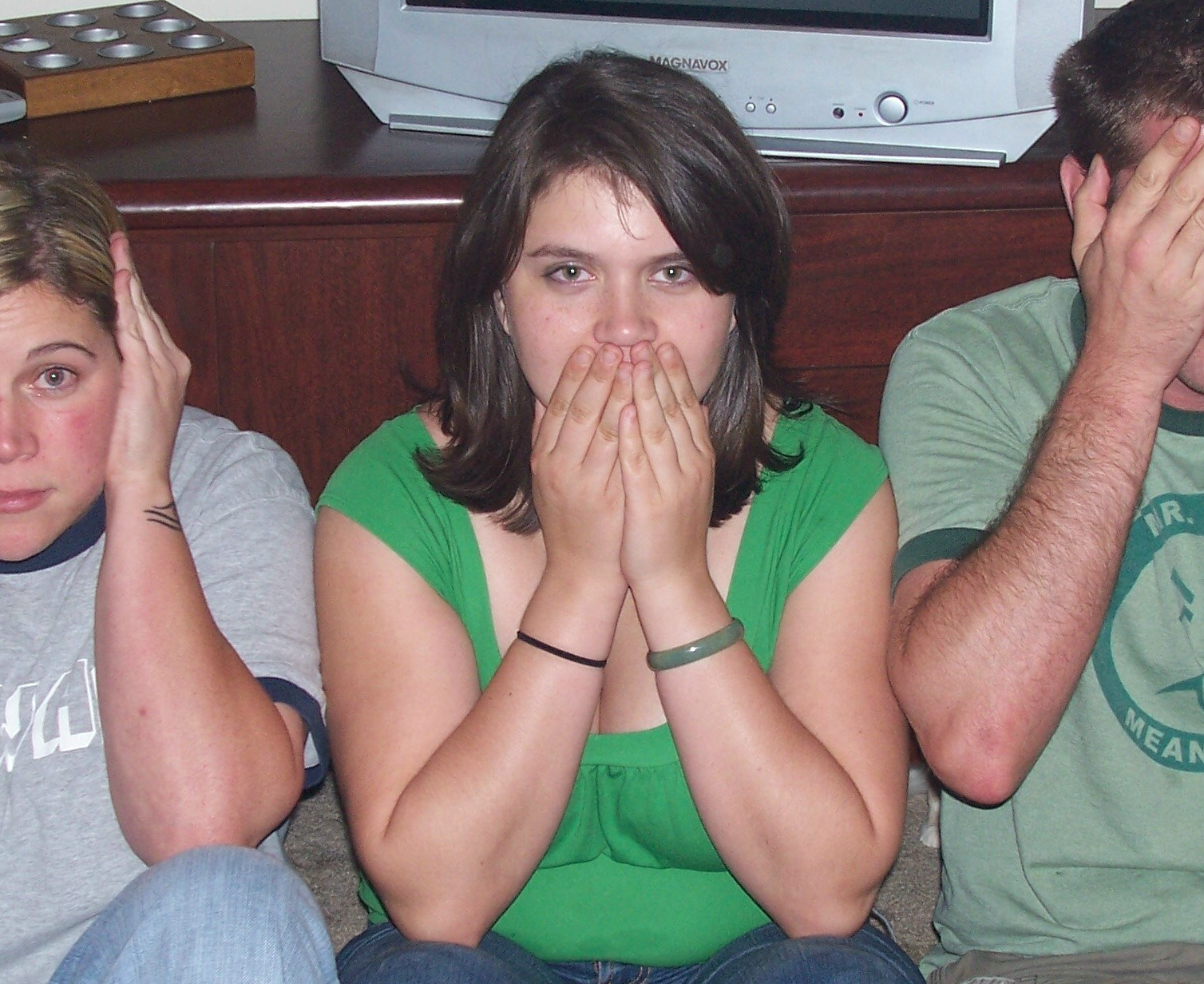
Hear no evil, speak no ev... Well you know the rest. By Barbara Burton
Hear no evil, speak no ev… Well you know the rest.  Photo courtesy of Barbara Burton.

Do you swear in the workplace?  I bet you try not to, at least not too often.  But sometimes it slips out, and sometimes it just feels right.  What do we know about the effect profanity has on our candor and our emotional closeness to others?

Years ago, I was driving my two-and-a-half year old daughter to childcare.  It was cold out, and she was safely bucked into the car seat in the back.  We lived on a major street, and I drove Westbound a half-mile to the nearest red light.  There was a car in front of us with the right turn signal on, but they weren’t turning.  My daughter said “Get out of the fawa way.”  My head tilted, and I ran the phrase through my head.  “Sweetie,” I asked, “what did you just say?”

“Get out of the fucking way,” she announced.  I contained my laughter.  This was her first F-bomb, and I had just enough self-control to realize I couldn’t teach her this was funny.  I had to keep this social.

“Darling,” I asked, “where did you learn to talk like that?”

“Mummy talks that way every time she drives.”  I gripped the wheel and tensed my facial muscles, using all of my life force to resist laughing.  The light changed, and we continued driving.  I turned into the ever-familiar cul-de-sac, and we stepped into the childcare to take off her shoes and jacket.  I asked our childcare provider, Liliana, if I could borrow her phone.  I said there was something I needed my wife to hear.  Liliana said she knew what this was about.  She was experienced.

I phoned my wife who was at home on maternity leave bonding with our second child.  “Hello?” she answered.  “Hi, your daughter just said something and I want you to hear it” I said.  “Oh, this can’t be good” she cringed.  I handed my daughter the phone and prompted her to “Say to mummy what you hear her say every time she drives.”  She was wearing a cute little dress with pink flowers.  She held the phone to her ear and yelled: “Fuckin’ mooove!”

What the Science Says About Profanity

What does swearing accomplish, really?  Citing excerpts from Emma Byrne’s Swearing is Good For You a Wired article from January 2018 described several behavioral experiments involving swearing.  In one, test subjects were asked to submerge their hands in ice water until they could not tolerate it any more.  Some were asked to state neutral terms describing furniture, and others were asked to say a profanity.

“…when they were swearing, the intrepid volunteers could keep their hands in the water nearly 50 percent longer as when they used their non-cursing, table-based adjectives. Not only that, while they were swearing the volunteers’ heart rates went up and their perception of pain went down. In other words, the volunteers experienced less pain while swearing.”

Enduring physical pain was also associated with aggressive game-playing, and a willingness to harm others in a simulation in which they could choose to shock others.  There’s a cross-over between insensitivity, enduring discomfort, mean-ness, and profanity.  Hence our vocabulary is so much richer when driving.

Swearing also makes people physically stronger.  Athletes can attest to this.  In one study cited by the Guardian people swearing while operating an exercise bike saw their peak power increase by 28 watts.  In another test, profanity increased grip strength by 2.1kg.

We can envision a profanity-rich working environment where people exert physical effort and occasionally get hurt.  I imagine construction sites, the armed forces, and resource sectors as places where swearing might just be a normal coping mechanism for the physical environment.  But what about an office environment?

Directly quoting Byrne’s book once again, an article from the Cut noted

“From the factory floor to the operating theatre, scientists have shown that teams who share a vulgar lexicon tend to work more effectively together, feel closer, and be more productive than those who don’t,” she writes. …A study published earlier this year backs up this and other research, suggesting swearing with colleagues can help create “a sense of belonging, mutual trust, group affiliation … and cohesion.”

Referencing other research, the article noted that profanity “…does still carry some social risk — it’s still a little bit taboo — so it imparts a feeling of trust in whomever you’re swearing with.”

Profanity Must Be Distributed Fairly

It’s interesting that we would trust people who swear more.  On one hand, people are going against the current to express a more candid emotional state.  On the other hand, people who break all the rules tend to swear more… and those people aren’t more trustworthy.  There’s a good review of the literature by Scott McGreal in Psychology Today, in which he looks at three different studies about honesty and swearing.  McGreal concludes the findings are mixed and sometimes contradictory.

A frustrating feature of this trust and solidarity is the double-standard on the use of profanity.  In the article in the Cut, Byrne noted men and women used to both swear with abandon until the early 18th century. Then women were encouraged to adopt cleaner language.  Men, by contrast retained the right to swear, using their power to express a full range of emotion.  To this day, there is more judgement when women swear, compared to the men’s presumed freedom.

My question is, if there’s a workplace that has a mixture of men and women, how are people to experience equality and camaraderie without a level playing-field for profanity?  If it’s male-stereotyped work involving physical strength and the endurance of pain and discomfort, do we disadvantage women in those workplaces by discouraging them from swearing?  And what about female-dominated work in health care, child care, and food services that often require strength and the enduring of pain and discomfort?  Those are customer-facing work environments, so some decorum is in order.  Are we discouraging full workplace performance by requiring lady-like vocabularies?

Besides, who ever said that women should swear less in the first place?

One thing’s for certain, this opinion did not come from my wife.

I wish I was insecure

teenage confusion, by Pabak Sarkar
teenage confusion.  Photo courtesy of Pabak Sarkar.

I wish I was more insecure, so I could relate better to colleagues who struggle with their insecurity. I keep missing opportunities to share moments of vulnerability.  I can’t tap into that common language where we all wish we were better.  People watch me, waiting for me to trip-up, and then I succeed.  Then they stop watching.  This is not how you get likes.

Perhaps I can overcome this challenge by doing more research.

My greatest frustration is articles proclaiming that almost everyone is insecure.  From a Huffington Post article by Susan Winter:

Every human being wonders if they’re “okay.” That’s the big secret no one shares and no one wants to share.  …at the core of every human is the desire to be accepted and seen as valuable in the eyes of those around us.  …There will be times you’ll feel on top of the world and times you’ll doubt your worth. This is normal. It’s a part of our forward movement as we take stock of who we are, in transit to who we’re becoming.

I feel like the captain of a Star Trek vessel observing “the planet of the insecure” hesitating about whether I should help.  If I could cure this planet of its insecurities, would their social order fall apart?  Would I take away that one thing that moves them forward every day?

What Teenagers Learn About Status and Insecurity

In this age of industrialized narcissism, the insecure are way better at delivering photos of their perfect life, drawing attention to their accomplishments, and working late to meet high expectations.  In an Inc.com article Jessica Stillman cites Yale psychologist Mitch Prinstein, who bemoans that a growing number of platforms are making it easier for us to gain status.  Prinstein differentiates between two types of popularity, status and likability.  Those who pursue and achieve high status tend towards “aggression, addiction, hatred, and despair.”

It’s great television.

In another article Stillman argues you should be relieved if you were not a cool kid in high school.  Cool kids get their reputation through behaviours that must become increasingly extreme in order to keep up with their subgroup.  At some point these antics veer into criminal behaviour and drug use which peers realize isn’t cool at all: “by the age of 22, these ‘cool kids’ are rated as less socially competent than their peers.”

By contrast, those who focused on developing one really close friendship “reported lower levels of social anxiety and depression and higher self worth as young adults.”  Nerds and healthy people work on their likeability.  Not facebook likes – that’s just a type of status.  I’m talking about people liking you for who you really are.  This is hard work. You need to make yourself vulnerable to close friends.  Sincerely attempt to improve yourself.  Be authentic in your words and deeds.  Back to Susan Winter’s Huffington Post article…

A truly empowered person can look at their shortcomings and seek improvement. The arrogantly insecure must only see a mirror that reflects their perfection. …The nature of growth requires embracing the new and unexplored. Security is opposed to growth, as growth is chaotic and unsettling.  Insecurity is the gift of wondering what comes next in our discovery process. [Emphasis added]

Insecurity is a good thing?  I’m furious.

Defining Emotional Security and Its Evil Twin, Insecurity

When doing people analytics, the first pass at the numbers often hinges on a data definition that needs better clarity.  Humanity is ambiguous and the closer we get to precisely measuring people, the more the human element claps-back at the empirical system, exposing that it’s the quantitative models themselves that are vulnerable.

Insecurity is “a feeling of general unease or nervousness that may be triggered by perceiving oneself to be vulnerable or inferior in some way, or a sense of vulnerability or instability which threatens one’s self-image or ego.”

Wikipedia has a great article on emotional security, which by default gets into insecurity.  Wikipedia is the source of consensus amateur opinion, which is perfect for you and me.  I mean you.  No offense. Insecurity is “a feeling of general unease or nervousness that may be triggered by perceiving oneself to be vulnerable or inferior in some way, or a sense of vulnerability or instability which threatens one’s self-image or ego.”

Already we’re in a pickle given Brené Brown’s research that the quality of our relationships depends on our ability to make ourselves vulnerable to others on a topic of personal shame.  To go deep in a relationship, we must choose to be insecure.  Those high school kids with one close friend were onto something.

Is There Anything Tangible We Can Do About Insecurity?

Is there anything tangible about insecurity?  Yes. Wikipedia says

The concept [of Emotional security] is related to that of psychological resilience in as far as both concern the effects which setbacks or difficult situations have on an individual. However, resilience concerns over-all coping, also with reference to the individual’s socioeconomic situation, whereas the emotional security specifically characterizes the emotional impact. In this sense, emotional security can be understood as part of resilience.

Some people have a status and/or demeanor with which they can weather setbacks better than others.  Therefore the emotional state of insecurity relates to 1) things that do in fact happen to us, 2) our ability to adapt to those things that happen including our own actions, and 3) our perspective and emotional state that arises from our experiences and adaptations.

This trifecta reveals that there are multiple responses to these shocks to our lives.  We can prevent bad things from happening through precautions and defenses.  We can mitigate after things have happened through insurance claims, emotional debriefs with friends, or by pressing charges.  We can improve our adaptations by upping our game (by trying harder or changing our methods as individuals), or fighting back against a collective injustice (e.g. go to a rally or make a targeted donation), or sometimes just letting others win (e.g. I hereby choose to load the dishwasher).

Or we can choose a different perspective and emotional state, such as accepting flaws in ourselves, in others, and in the world at large.  There is comfort in humility.  If you don’t like that, there’s always hope.  Choose your emotional posture.  Shape the clouds with your own bare hands.

What a Secure Workplace Looks Like

Now, let’s consider what this means in the workplace.  If an employee knows what is expected of them every day, they can correctly self-assess if they are delivering on expectations and change course accordingly.  If an employee has one good friend in the workplace, they can share vulnerable moments in which they are reassured and accepted as who they are.  If an employee is mistreated or put at risk, they can only prevent and mitigate if they are free to complain, talk to the union, or refuse unsafe working conditions.  If the employee faces unexpected dental expenses or fears poverty in retirement, they focus better when their employer provides pensions and benefits.

Take insecurity seriously, it’s the main engine.

The employer is asking people to do work for them, and in return offers an environment that is economically, physically, and emotionally reassuring to their security.  Take insecurity seriously, it’s the main engine.

There we go, my work is done.  It’s amazing what you can learn about a topic you know nothing about by putting a few hours into research and explaining things.  It feels accomplished.  It’s not that I was feeling insecure earlier.  I wasn’t.  I’m only doing this for you.

Do you like it?