The Real Big Picture Is Your Own Personal Experience

dawn-flight-by-john-fowler.jpg
Dawn Flight.  Photo courtesy of John Fowler.

I think we’re entering an era where the real big picture is just a composite of individual subjective experiences.  I’m sure this concept has been done to death by a bunch of great philosophers, but I want to lay this out in simple terms.

As we look at workplace disruptions, it seems each disruption just blurs into the next in an overall environment of unwieldy surprises that we can’t get on top of.  Amazon has begun to displace bricks-and-mortar retail, trade and immigration have let to major political disruptions everywhere, Artificial Intelligence is expected to change jobs significantly, and the gig economy is disrupting work relationships in many ways.  In each case, it is a combination of technology and globalization driving big-picture disruption.

The Ground Level View of Big-Picture Change

Yet the real-life impact is personal.  I encourage you to step away from the objective birds-eye view and consider that you yourself are affected by these changes.  These changes affect the work you do, how you get goods and services, and probably your personal life as well.  You don’t have an opportunity to sit still even if the changes are favourable to you.  And if the changes are unfavourable, you are put-upon to mitigate, resist, or take better advantage next time around.  We’re anxious and we struggle with the acceptance of ambiguity.

Now, let’s switch back to the birds-eye view.  If you are in human resources or if you are a leader in some way, you must also consider the perspectives of many employees trying to make their way in a similar manner.  You’re probably expected to help guide them.  This means that you need to foster a general environment of empathetic relationships, trust, and an awareness of context.  While some of the impacts of change are measurable and technical, first you need to help others become comfortable in their own skin.

First Build Your Own Resilience to Change, Then Help Others

You can’t help others with this until you have gone through the process yourself, and figured out where you place yourself in this crazy world.  If you’re a fast learner, you can figure yourself out before you’re obliged to teach others to do the same.  It’s like the airplane safety demonstration; install your own emotional oxygen mask before helping others.

What is most significant about this business environment is that it heralds an era where people outrank the system.  You can talk all you want about how we should organize citizens and families and employees towards their best efforts.  But if you attempt to advance a birds-eye view of people at all times, it begs the question, are you just some bird in the sky?  When people are standing on the ground and a bird sails past, under what circumstances are they concerned about the bird?

You can attempt to prescribe a vision, foster collective purpose, and create policies and systems that are somewhat universal.  But then one person puts their hand up and says, “what about me?”  And you’re stuck.  You’re stuck because you want to say the same thing.  And if you take a moment to look at peoples’ eyes, you realize we’re all thinking the same thing.

Look at the desks, the walls of the buildings, and the mouse under your hand.  These physical things have no soul.  So what’s so special about your organization?  The secret ingredient is you.

Don’t Hate Mayhem. Love Complexity Instead.

You Better Hold On. By Jane Rahman
You Better Hold On. Photo courtesy of Jane Rahman.

The strongest defense against a bewildering world is a love of complexity and ambiguity.

Elif Shafak, Turkey’s most popular female novelist, has provided a brilliant critique of our modern times.  In her TED Talk from September 2017, she expresses concerns about economic uncertainty, the impact this uncertainty has on our emotional bewilderment, and knock-on effect this has on the appeal of demagogues.

“Ours is the age of anxiety, anger, distrust, resentment, and I think lots of fear.  But here’s the thing:  Even though there’s plenty of research about economic factors, there’s relatively few studies about emotional factors.  …I think it’s a pity that mainstream political theory pays very little attention to emotions.  Oftentimes, analysts and experts are so busy with data and metrics that they seem to forget those things in life that are difficult to measure, and perhaps impossible to cluster under statistical models.”

Speaking as a workforce analyst, these are my sentiments exactly.  People like me often try to figure out what is happening inside the workplace while thinking of employees as livestock or machines.  But then the people talk, and their souls come through.  Their context and their lives prevail over objective definitions of effectiveness.  Workplace culture overpowers the declarations of those with authority.

Emotional Complexity Amidst Demographic Over-Simplification

Nowhere do I see this more than when I split a dataset into demographic categories.  The categories are usually either-or scenarios, such as age bracket, binary sex, or length of service.  And just as we find the definitive behaviors and opinions of a certain category of people, with a little more digging we find that there is a deeper human story that defies categories.  I see men taking parental leaves, older workers expressing career ambitions, and high-school dropouts with unmet educational needs.  Putting people into categories only helps find a demographic that best gives voice to the human story.  But that human story will usually speak for everyone.

Shafak, who understands human stories, notes that demagogues “…strongly, strongly dislike plurality.  They cannot deal with multiplicity.  Adorno used to say, ‘Intolerance of ambiguity is the sign of an authoritarian personality.’  …that same intolerance of ambiguity, what if it’s the mark of our times, of the age we are living in?  Because everywhere I look, I see nuances slipping withering away.  …So slowly and systematically we are being denied the right to be complex.”

To Shafak, it is the bewilderment imposed upon us by change that makes us susceptible to the simple ideas offered by demagogues.  “…In the face of high-speed change many people wish to slow down, and when there is too much unfamiliarity people long for the familiar, and when things get too confusing, many people crave simplicity.  This is a very dangerous crossroads, because it is exactly where the demagogue enters into the picture.”

Emotional Intelligence, Embracing Complexity, and Building Resilience to Organizational Change

Shafak suggests that “…we need to pay more attention to emotional and cognitive gaps worldwide.”  Those who struggle with complexity and ambiguity need our help.  We’re not at liberty to define non-complex people as the “other,” as people whose opinions we can reject in yet another polarizing simplification.

I felt this concern when I followed the James Damore incident at Google.  A programmer on the autism spectrum was fired for writing an anti-diversity manifesto, and his memo showed that he struggled with sensitivity training in a culture of diversity.  He attempted to attribute the onus of emotional intelligence to a liberal bias and the imposition of allegedly feminine social concerns.  The true lesson was not so much that bigotry sucks; it is that simplified emotions make us prey to extreme opinions.  I think we need to devote more time and energy to empathizing with the perplexed.

Shafak is insistent that we must cherish complexity.  We must value ambiguity.  We must allow ourselves to carry multiple identities and become the cosmopolitan people who can adapt to the world.  For me, I felt reassured that a deep curiosity for new information and enthusiasm for diverse views is the ultimate resistance against bad ideas.

With complexity we can have a meaningful society, meaningful work, and a resilient sense of self that allows us to move forward.  Only then can we get back to work and do our jobs well.

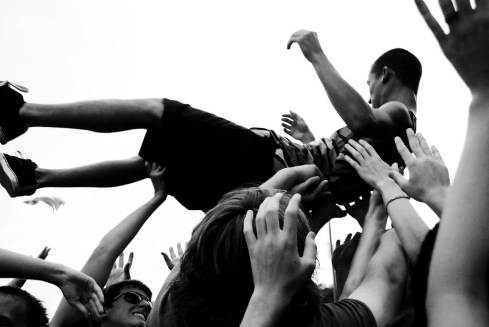
Forget About Strategy. Reality is a Mosh Pit

CROWD S U R F E R. By Keami Hepburn
CROWD S U R F E R. Photo courtesy of Keami Hepburn.

Strategy is not superior to tactics.  At best, strategy and tactics can be integrated as equals.  In this day and age it is looking increasingly unlikely that a senior leader will come up with one brilliant idea from the top of the organization and cascade it downward through the chain of command.  Rather, we live in a world where ground-level employees determine business success; information is diffused through friends and cube-mates; and the best ideas move diagonally through the organization’s subject-matter experts with minimal regard for the org chart.

A classic example of the disputed importance of strategy is the difference between Workforce Analytics and Strategic Workforce Planning.  I routinely use Workforce Analytics to help a variety of managers and professionals adapt to an unpredictable array of questions.  Workforce Analytics has a kind of “older sister” business practice called Strategic Workforce Planning which has been around for a little longer.  Strategic Workforce Planning is the practice of using analytics in the formal process or organizational re-design.  The re-design is intended to align human resources to internal and external context, a forecast about the future, and organizational strategy.  It makes perfect sense on paper.

In my opinion, there are three major frustrations with strategic alignment.  First, it makes a presumption that organizational strategy in your organization is in its prime.  If your org strategy is in its final approval stage or a complete re-write of that strategy is about to begin, then alignment to that strategy is a dubious effort.  Second, if any of the organization’s major leaders are in transition (both incoming and outgoing) their personal enthusiasm for the formal strategy could be in play.  To some extent, strategy is a debate amongst executives, and that debate can shift as the players are in flux.

Third, forecasting is a moving target.  In the middle of the Strategic Workforce Planning process there is an attempt to identify a future state and assess scenarios where a different staff composition would prepare the organization for that future.  However, society is changing so quickly and in so many ways that speculation about any likely future state has the shelf life of about a month.  Try writing down your predictions about the future on a piece of paper and then come back to it in 30 days.  With the passage of time you will either be humbled, or you will assert that it’s been doctored and you couldn’t have written something so clueless.  As such, alignment to strategy is brief, making the overall process less tangible and less relevant.

A good example of the struggles of strategic alignment is Uber.  Uber appears to have been built around a culture of rules-breaking on taxi licensing, grey-ethics exploitation of private information about a customer’s physical location, and a backroom culture of dot-com, locker-talk bravado.  With just a little bit of blowback from the public, Uber has been obliged to change senior leaders and reverse elements of the very organizational culture that made it great.  Good luck identifying what their sector will look like in two months, what this week’s executive team is going to do about it, and calibrating staff accordingly.  They might be fine in the near future, but we won’t really know until after the fact.

Consider by contrast an impactful tactical change which adapts to emerging evidence.  There is evidence that an equitable and inclusive work environment fosters better commitment and idea sharing.  There is evidence that workplace incivility has a dramatic impact on general productivity.  There is evidence that customer engagement is hyper-sensitive to employee engagement.  It is possible to develop a supposition that millennials are quitting at a higher rate, only to discover evidence that this is more nuanced and is really about career advancement at all ages.  These insights can have a dramatic impact on an organization’s opinion about what their core function should be, how managers should treat employees, and what kinds of employees and managers you should be hiring or promoting.

Then you would need to double-down and anticipate that even more disruptive evidence will continue to arrive at an even faster rate.  And if you did not adapt in this manner, you can bank on the fact that this adaptation is happening at rival organizations.  This brings us back to the possibility of even more leadership change and yet another re-vamp of organizational strategy.

If you are a manager, a human resource leader, or an analyst you might need to abandon all delusions that you can chart a clear path.  Rather, you are in the mosh pit of life, and your prime directive is to keep moving and not get hurt.  Keep your tempo, have fun, and follow the mood.  You cannot simply obey the directives of those with money or rank.  You must arrive at work fresh and rested, and play hard.  Every day.

Workplace Incivility Drags Workplaces Back to Stone Age

neanderthal-museum-by-clemens-vasters.jpg
Neanderthal Museum. Photo courtesy of Clemens Vasters.

How important is good manners?  Really, really important.  And it extends much further than knowing what an oyster fork looks like.

Incivility weakens health in areas such as cardiovascular disease, cancer, diabetes, ulcers, and of course mental health.  For reasons of reducing health care claims alone, mistreatment of staff should be curtailed.  However, preventing workplace incivility is actually a bigger deal than originally thought.

In fact, there is significant research that shows being outright rude to colleagues is a major killer of workplace productivity.

In my jurisdiction, there was legislation brought in a few years ago that obliged employers to curtail bullying and harassment.  The legislation goes beyond the long-standing human rights legislation preventing harassment on prohibited grounds, such as sexism or racism.  The new rules say that if we are to compel others to action we must not be aggressive, humiliating, or intimidating.

Uncivil Workplace Culture Adversely Affects Productivity

According to her research, Christine Porath found that for those treated rudely by their colleagues:

  • 47% intentionally decrease the time spent at work
  • 38% deliberately decrease the quality of their work
  • 66% report that their performance declined
  • 78% said their commitment to the organization declined
  • 80% lost time worrying about the uncivil incident
  • 63% lost work time in their effort to avoid the offender

In addition to the reduced productivity of those who stick around, there is also the consideration of those who quit.  Twelve percent of those treated poorly leave the job because of the incident and, by contrast, those who are treated well by their manager are more likely to stick around.  What is interesting from an analytics perspective is that those treated poorly don’t tell their employers why, making it a blind spot in the data.  We know this from other sources; it’s always okay to say that you’re leaving for a better opportunity elsewhere.  But employees usually quit because of their manager and refuse to talk about it in exit interviews.

In addition to those directly treated in an uncivil manner, those who observe someone else being treated in such a manner are also affected.  “You may get pulled off track thinking about the incident, how you should respond, or whether you’re in the line of fire.”  Those who witness incivility see their performance halved and they “weren’t nearly as creative on brainstorming tasks.”  It makes sense that behavior is social and contagious, and that we feel for those around us.  That includes emotional pain.

The impact is not just contagious between employees, but it also spreads to customers.  In research conducted with two colleagues form the University of Southern California, Porath found that “…many customers are less likely to buy from a company they perceive is uncivil, whether the rudeness is directed at them or other employees.”  When customers witness an uncivil episode between employees, that customer makes generalizations about the company.  This has happened with Uber; customers who perceive a toxic environment have turned to competitors.

It’s more evidence of an emerging business model I refer to as double engagement.  That is, that it is engaged employees who attract and retain engaged customers, causing the revenue flow that marketing and finance want so desperately.  The days of investors and marketing teams driving a product or service into the hands of witless customers is long gone.  We live in a world where being human dictates business strength.

But before we put this all in the hands of the worker, we should note that the main source of an organization’s emotional tone comes from its leadership.  Simply put, when leaders treat their team fairly and well, they are more productive.  The team goes above and beyond.  They have more focus, better engagement, more health and well-being, more trust and safety, and greater job satisfaction.

For leaders, the new bottom line must also now include compassion, emotional sensitivity, and engagement.  You must step away from individual heroics and reverse your sense of who is important.  Why? Because way down at the bottom of the pecking order there may be someone who is not treated so well.  Whether you’re a caveman or a gentleman, if you are stronger and more powerful it is your job to carry them.

How to Become Strong By Understanding Disadvantage

2012 Marine Corps Trials Day 2.  Photo courtesy of DVIDSHUB.

We hear lots about excellence these days.  So what are the opportunities for persons with disabilities and disadvantages to drive excellence?  It may be that those who are in the throes of disadvantage might not have a fair shot at success.  But there are opportunities for everyone to aspire to excellence, through the cultivation of empathy for those who are disadvantaged.

This is a touching article about a doctor who was concerned about his own mother during her  disabling illness.  The illness was Parkinson’s disease, a degenerative disorder that affects movement.  In the Times article, Dr. Sandeep Jauhar is rigged with a device that allows him to personally experience the sensation of his muscles turning to jelly, like those who have Parkinson’s, like his mother.

Why would he do such a thing?  Because he always wanted to understand his mother’s perspective during the illness.  Devices are also available that replicate the effects of emphysema, psychiatric illness, and nerve disease related to diabetes.

While I haven’t experienced it yet, I have also heard rave reviews about a similar effort called Dark Table.  Dark Table is a restaurant in Vancouver where food is served and eaten in a room which is completely dark.  The servers are blind or visually impaired, and the guests commit to keeping their gadgets off and eating their meals in the dark.  The dark dining experience increases the awareness of other senses such as hearing, touch, and taste.  It creates jobs for persons with disabilities.  And it also helps people empathize with the perspective of the visually impaired.

Emotional Intelligence in Workplace Conflict

On the human resources side of the fence, it’s possible to develop greater empathy for those we are in conflict with.  The nurturing of empathy is important for industrial relations, the professional development of managers, performance conversations, and the general growth of all staff.  How do you teach workplace empathy?  I have been involved in complex roleplay scenarios called Conflict Theatre.  The theatre scenes are designed so that each scenario is integrated into well-developed back stories and emotional perspectives of the actors.

The theatre is presented so as to invite audience members to step into the shoes of an individual actor and attempt to change the course of the conflict.  It’s one thing to sit back and observe from and armchair, and develop an opinion about how things should be done.  But the real expertise is to understand the full emotional context of each player in a conflict, an understanding which is far more vivid when experienced directly.

Empathizing with diverse perspectives turns out to be a key attribute of those who face conflict with dignity and grace.  It takes you beyond the negotiations that resembles bartering for trinkets, and even beyond the interest-based bargaining of those vying for a win-win solution.  You have to learn how to understand people as individuals based on their perspective and story, not their category or “type.”  This includes understanding their perspective when they struggle with ability, whether it’s professional ability or impairments.

Using Emotional Intelligence to Improve Workplace Culture

The thing I find fascinating about these initiatives is their scientific and cultural back-story.  The Parkinson’s device was built in response to well-documented complaints that patients perceive their nurses and doctors lack empathy for their hardships.  Blind dining is traced back to Switzerland by a man named Jorge Spielmann, whose concept was imitated in restaurants in London, Paris, and New York.  Conflict Theatre in Vancouver comes out David Diamond’s Theatre for Living, which itself comes out of Theatre for the Oppressed, created by Augusto Boal in Brazil in the 1970’s.  Theatre for the Oppressed, as you might guess from the name, arises from social critiques and movements to overcome repression, with an intellectual legacy dating well back into the 50’s.

To affect society on the larger scale we need to reach into the emerging science, the social experiments in many countries, and the lessons learned many decades into the past.  The knowledge and confidence of those with power and privilege can pale in comparison to the universe of individual experiences.  In order to take full advantage of the best information when advancing ourselves in this world, we need humility about how right we truly are, curiosity for knowledge that is new, and sensitivity to the lessons from other cultures and other moments in time.  Only then can each of us aspire to excellence.

Is Workplace Culture the Right Kind of Revolution?

The wall of plexiglass, by ebt47563 (=)
The wall of plexiglass.  Photo courtesy of ebt47563.

Exactly how do you change organizational culture?  This is a good HBR article from June 2017 about attempts to change corporate culture from the bottom-up.  It’s a story about Dr. Reddy’s, a global pharmaceutical company based in India and led by G.V. Prasad.  The authors are Bryan Walker from IDEO and Sarah A. Soule from Stanford Business School.

Dr. Reddy’s process of culture change began with significant ground research to find out what their staff, providers, and investors needed when dealing with customers.  They brought their goals down to four simple words that brought it all together: good health can’t wait.  Instead of selling the slogan through posters and speeches they chose to demonstrate their purpose through actions.  The initiative named projects in packaging, sales, and internal data to advance the new vision.  There were some immediate impacts.  One scientist broke a number of company rules and produced a new product in 15 days, having prioritized new efforts to match the vision.

The comparison to social movements is important, because movements start with an emotion rather than a call to action.  Movements start small, “with a group of passionate enthusiasts who deliver modest wins.”  Momentum builds through networks, penetrating power structures and leadership.

There are also “safe havens,” places where activists can behave differently from the dominant culture and discuss their goals.  In innovative organizations, research labs are often built as separate mico-organizations that cultivate change as prep-work for the larger organization.  This story resonates with me, because disruptive workforce analytics will occasionally fall of deaf ears.  The analysis needs to be created in a manner which partially ignores pre-existing agendas or presumptions of how things would normally be done.  The decision of whether to apply new ideas might belong within a more formal process, but when experimenting with messy new ideas, to be sequestered is ideal.

Beyond the HBR article two additional models are appropriate to discuss the nature of change.

Innovating Technology and Trends Through Social Networks

The first model is the diffusion of innovations as described by Everett Rogers.  In this model, there is a small avant-garde of weirdos who just get into stuff that is new and interesting.  That crowd of innovators will not have the full opportunity to make money or make it big.  But their new findings diffuse through social networks, based on peoples’ network connections and their readiness to consider new ideas.

There are several hold-outs, such as the laggard crowd who resists change until it is impossible to do so.  The biggest difficulty is the early-stage challenge of “Crossing the Chasm” where the new idea has won-over a small crowd of early-adopters who are about 13.5% of the population.  The challenge is that sometimes there’s something about the new idea that doesn’t mesh with the next crowd, the early majority.  Some examples might be that the new technology has a difficult user interface, or the social trend is incompatible with the conventional lifestyle of those in the burbs.

In my opinion, the classic example of this challenge is the hands-free bluetooth headset that you see people wearing when they’re talking on the phone while walking down the street.  The technology has been in public for more than fifteen years and our first instinct is still that we want the caller to get professional help.  And that’s even when you’re not also angry at them about a misunderstanding.

Using Social Disobedience Tools to Change Workplace Culture From Within

Another compelling cultural change model is the Spectrum of Allies model from George Lakey of Training for Change.  Lakey is highly experienced in training social justice activists in civil disobedience.  I attended a couple of workshops with Lakey when I was part of the labour movement, and his spectrum model is eye-opening.

The key diagram is a semi-circle, kind of like a half-order of a large pizza with six or eight slices.  The idea is that everyone can be categorized according to their level of enthusiasm for, or resistance to, an agenda or new idea.  Then you lay these wedges out in order, with the most supportive categories on the left and the most resistant on the right.  Your goal is to shift all of society one wedge to the left.  That is, the biggest hold-outs still get your attention, you’re just trying to convince them to become only moderately opposed to your goals.  Those in the middle, you can tip towards you slightly.  Those who are with you from the start, those are your strongest advocates and you can start giving them more work.

What really holds the model together is that you are shifting the entire social culture towards your way of thinking, resulting in culture change.  Everyone is a big deal, everyone receives the attention they deserve.  It’s very different from that us-against-them stuff that we’re accustomed to seeing during elections.  And it is very different from the notion that the main difference in the key players is their place on the org chart.

What this means for workforce analytics, is that you will require several different vehicles to bring meaningful information into human resource decision-making.  While there will be those who are hungry for the information, there will be others who need to simply be sold on the notion that it is not a threat.  While innovative findings might be compelling amongst an in-crowd, getting the information through cliques and interests will require bridging links and data translation.  You can build new ideas in self-imposed isolation, but at some point you step into public and advance it your ideas through the audience.

But before you step out, please put away your Bluetooth headset.