Wot You Lookin’ At. Photo courtesy of Kate Russel.
How do you really know if someone is trying to fool you? Sometimes it’s easy. You know the kid took the cookie. You know the employee wasn’t sick. You know corporate is just cutting costs. But big data makes it harder to know what to believe. The raw data takes hours to read and is in a specialization that is not your area. Everyone who works with the data is beholden to an interest. And what if that cool thing the data scientists have figured out his how to scam you as a target? Thankfully, there is help.
A recent article from the New Yorker advises on How to Call B.S. on Big Data. It’s a great summary of a course at the University of Washington which became available in January 2017. In the spirit of public education, you can access a large amount of the materials in the course’s web site with videos, tools, and case studies.
There are some simple protective measures that are known to those in the number-crunching fields. Watch out for unfair comparisons; remember that correlation doesn’t imply causation; and beware of the hubris of those making bold claims. On average you need to keep information in context and ask for a plausible theory about why a fact would be true. The plausible theory is your hypothesis, and the scientific method is to test the hypothesis. No plausible theory; no science.
Amongst the precautions is that data taken from the general public will often re-create prejudice. I see this all the time when looking at inequalities in women’s promotions and salaries. Superficially it does appear that many women are self-selecting into less onerous careers. Deeper into the analysis, you tend to find that women do more than their share of the caring (in all of its forms) and that it’s a pervasive imposition, a subtle stereotype, and just about everyone is causing this to happen.
I’m glad to know that there is a growing desire among non-quants to consume information in a more sophisticated manner. For my own work, this doesn’t worry me. I’m honest and my motives are transparent [about stuart] If anything, I’m intimidated by the volume of work ahead of me. I used to have a clear sense of the amount of work required to seek the truth in the data and share what I found with a sincere audience. Since the rise of fake news and the increasing complexities of social media, a Pandora’s Box has been opened people like me are obliged to investigate ten times as many topics. We may be asked to fact-check nonsensical statements, defend controversial findings that were created in a neutral setting, or spend excess hours establishing credibility.
The most unsettling concept raised in the article is the BS Asymmetry Principle coined by Alberto Brandolini: the amount of energy needed to refute BS is an order of magnitude bigger than that needed to produce it. And so begins the new hybrid skill set of doing good math, and then talking about it properly.
The world is complicated. Do corporate leaders think this is a good thing? No, they do not. There is an emerging effort to put a greater priority on keeping things simple, while human resources leaders get their people to adapt to changes in the nature of work.
In June of 2014, Josh Bersin developed a fresh opinion that simplicity is the next big thing. (You’ll need to click past the Forbes pop-up screen, but then you’re in) Large global corporations were at the time expanding their business, organizing mergers and restructuring efforts, and putting talent management ahead of cost reduction. There was also a pre-existing struggle to redesign performance management, reduce workload for overwhelmed employees, and create a stronger and more integrated workplace culture.
Bersin notes “We have inadvertently become far too enamored with our technology, mobile phones, social networks, photos, video sharing tools, and all the various competency models, frameworks, process diagrams, and workflows we design in HR.” Indeed.
By contrast, some organizations have put a lot of effort into simplifying their approach. This could include reducing the number of competencies they encourage from seven to four, or reducing the performance management process to three simple steps, or creating apps that attach to their HRIS where the apps accomplish just one thing. Solutions become smaller items that almost belong on Etsy.
For those of you who have written a one-sentence email to an executive it is obvious that keeping it simple is more work, not less. Designing simple things for a lay audience also requires a special perspective and a devotion to good design. Yet concentrating effort and attention to just one thing has obvious payoffs in focus and effectiveness. I don’t have data. In this case, you can go on instinct.
Human resources departments and those who handle their data are expected to guard the best secrets. But one of the biggest secrets is ironically an anti-secret. Did you know you’re allowed to talk openly about your own pay? Don’t tell HR. It’s embarrassing (for them).
This article in Atlantic.com by Jonathan Timm from July 2014 draws attention to the dubious practice of pay secrecy. I’m not talking about the employer’s obligation to keep your pay information confidential. Rather it’s an article about employees being obliged to keep their pay a secret from one another. These obligations are referred to as “gag rules.”
For the uninitiated, there is no meaningful moral obligation for employees to refrain to talking about their salary with each other. On the contrary, in the United States there are regulations that protect employees’ rights to discuss working conditions with one another. It’s on the edges of the legislation that allows employees to collectively discuss their lot in life, bargain for improvements, and possibly unionize.
In that context the moral judgement should be obvious. Those handling the file at human resources desks are not allowed to advance anti-union behavior, and as professionals they should always advise against such policies.
The article describes personal experiences of people struggling with these fake rules. What is notable is how people presume these gag rules are legitimate, employers and employees alike. Gag rules create a sense of guilt about whether we should put ourselves ahead of the employer. They make us self-consciousness about whether we’re being greedy. We’re embarrassed to talk about whether we’re losers for being the lowest paid person. Raising the topic with colleagues is “akin to asking about their sex life.”
These emotions are powerful stuff. But then, that’s how bullying is done, isn’t it?
Above and beyond beef-and-taters union issues, gag rules are also wrapped up in discriminatory pay practices. That is, it is easier to under-pay women and visible minorities or play favorites if employees don’t talk about their pay. A woman named Lilly Ledbetter complied with the gag rule at Goodyear for nearly three decades and ultimately found out she was under-paid. Ms. Ledbetter sued and lost because she did not complain about being under-paid within the first 180 days of her first paycheck.
Ironically, employers share pay information with each other all the time. They’re called compensation surveys. They happen on an annual basis (if not monthly), and they are delivered through specialized consulting services. The work is done under careful checks and balances that ensure data privacy and keep the whole process fair and legal. Those who have worked on such surveys are proud of their work. I used to do compensation surveys myself, and I was good at it.
One of the reasons why compensation professionals love doing this work is because it helps make pay fair and equitable. Looking down from the ivory tower, human resources people know that perceived unfairness in pay creates discord. So “good” employers put some work into getting it right, behind the scenes, in a kind of lab environment where social justice is organized by experts. But really we’re just trying to stay one step ahead of the riff-raff.
Let’s face it, employees and the social justice movements they created are the rightful owner of this dialogue. Gag rules and compensation surveys are just the cultural appropriation of working class politics.
Which profession should you go to when seeking answers to a numbers puzzle? A true professional advances expertise in the area in which they are knowledgeable. By default this means that you must not advance expertise in an area where others know best. Understanding the boundary between what you know and what you don’t is critical. You make yourself stronger by knowing which profession to seek out. The following list provides examples of professionals who might (or might not) be able to help you, depending on your challenge.
Mathematician. Those who have done proper degrees in mathematics work in abstract mathematics or applied mathematics. Abstract mathematics will be familiar to those who learned concepts in high school that you have never applied since. In my case, trigonometry. Abstract math is required when creating models for applied mathematics, the latter of which solves real-world problems in many fields.
Statistician. These are people who have master’s degrees or doctorates on the applied side of mathematics. They work with large amounts of data solving real-world problems. In my dealings with statisticians, they are all about the statistical model; figuring out whether it works, is compatible with the data set, is compatible with the software they are using… and whether the client’s question has been answered. My impression is that statisticians are far more concerned about happy customers than mathematicians are.
Economist. Economists are in the social sciences and they are cousins to sociologists, psychologists, and a few other fields. Economics grapples with the social problem of finite resources in a context of infinite demand. Economists can work on public policy in areas such as central banking, trade regulation, or in a think-tank. They also work in business using data and models to help the business be more effective. They differ from statisticians in that they match their models to economic theory, not mathematical theory. In public debate in Canada there is a presumption that economic thought is about being politically right-wing; this presumption does not exist in other countries or even within the field itself.
Math Teacher. We need to single-out math teachers because there are a lot of them. They are also the single biggest driver of the public’s ability to deal with numbers. If you did well in high school math you are allowed to say you are good at math. If you say you are bad at math, everyone knows you had an unpleasant encounter with a math teacher who had an off-day.
Business Analyst. According to their professional association these people “…identify and articulate the need for change in how organizations work, and …facilitate that change.” This is great, because it’s problem-solving broadly defined and does not identify their data medium. My experience with Business Analysts is that they’re at the forward edge of re-engineering initiatives, and they function best when they are part of a multi-functional team. They could be accountants but they’re further ahead if they borrow from every business discipline, including process engineering, human resources, information technology, marketing, and finance. They’re the Holmes on Homes of strategy and organizational design. Without the tattoos.
Workforce Analyst. As I mentioned, Business Analysts work best when they borrow from a variety of fields. In human resources, they need business analysts who are able to borrow ideas from every specialization within human resources. This can include recruiting, employment equity, compensation, industrial psychology, health & safety, or industrial relations. Human resources data is immersed in the human element, entwined in statutory regulation, hyper-sensitive to collective agreements and union politics, and is exposed to a unique source of theory and evidence.
Institutional Analyst. This is the field that studies how formal institutions behave according to empirical rules and theoretical rules. There are two Nobel laureates who have influenced this field and the famed sociologist Max Weber influenced it through his work on bureaucracy. Institutional Analysis is at the threshold between sociology and economics. This is a big deal because the two crowds often don’t get along, because of a tweed vs. navy blue dynamic that is completely un-related to the facts at hand.
Actuary. This is a profession that measures and manages risk and uncertainty. A lot of actuaries work on pensions and insurance, because they calculate with some accuracy the likelihood that your house will be robbed, that you will crash your car, or when you will die. Actuaries have degrees in actuarial science, a specialization in mathematics. A lot of them work for consulting firms providing services to the back-office of major corporations. As such, you won’t meet them in your daily working life until you bump into them at a party, at which point they will never talk about the math. It’s like they’re secret agents or something. They calculate danger.
Accountant. This is one of the most long-established number-crunching fields, and makes up a large fraction of people who work with numbers on a daily basis. These people measure and report on financial information that helps others make decisions on investment, taxes, and cost-control. They are typically not boring people.
Financial Adviser. Financial advisers provide financial services to clients in the investment sector. They can help you figure out what insurance to buy, where to invest your savings, how to navigate rules on taxes, and how to interpret research and current events as they relate to your personal finances. Notably, the Wikipedia page on this profession spends two-thirds of its space describing the way the field is regulated. The problem is that they cannot predict the future even though you will ask them to, they sometimes get commissions for investment products they invite you to buy, and there are abundant one-sided horror-stories about poor advice. Yet they are extremely helpful because they can steer you away from obvious mistakes. Just remember: they, like you, are always working for the person who pays their salary.
Demographer. Demographics is the statistical study of populations – their size, distribution, and characteristics such as education and ethnicity. You have probably heard of Thomas Robert Malthus, who described how exponential population growth would guarantee famine and poverty (he was partially correct). Several workforce characteristics can be categorized by demographic traits, which is dicey because often the real driver of differences is the individual people, not their categories. Demographers run your national census, making the field controversial. In the middle ages, Christian thinkers opposed demography, including critics such as William of Conches, Bartholomew of Lucca, and Stephen Harper.
In human resources you might spend a lot of time talking about employee performance and what it means to be excellent, average, and under-performing. But your conversations about performance might be trapped in a decades-long mathematical error which skews your subjective judgements. It’s worth exploring assumptions about the bell curve performance distribution, if only to be a little wiser when you “use your words.”
You will often hear that high-performing employees are three times as productive as an average performer. I looked into it, and it’s not true. The differences in performance are far greater, in some cases six-to-one or more. I tracked down a good academic article by two Organizational Behaviour academics, tucked behind a paywall. The paper is “The Best and the Rest: Revisiting the Norm of Normality of Individual Performance.” Ernest O’Boyle Jr. and Herman Aguinis. Personnel Psychology 2012, 65, 79-119.
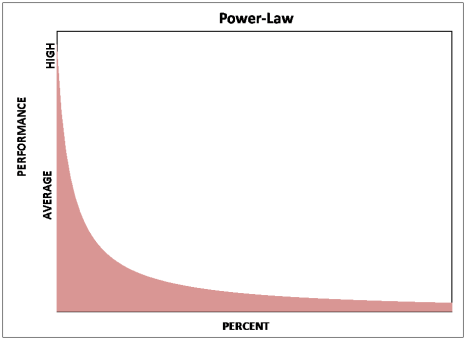
The authors note there is a decades-long consensus that employee performance is distributed on a bell curve. However, this consensus might be way off base. Through a series of studies, they show that the distribution of performance more closely resembles a power-law distribution. Here’s what the two distribution curves look like side-by-side.
The blue diagram should be familiar to most people as “the bell curve.” There are a bunch of proper names for it, but the features are well-known. The largest number of people is really close to the peak in the middle, which in this case is the average performance score. A bunch of people are a little to the left or little to the right of the average, and those are your below-average and above-average performers. Then there are tails on either side of the curve; those are the rare low and high performers who are often about to get terminated or promoted.
There’s another way to look at it. The rose-colored diagram is called a “power-law” distribution. (Note that in this case the axes are reversed so that performance runs up-down and percentage runs left-right). This diagram can reflect the likelihood that you will buy a rock album, with you and millions of others buying Beatles and Broken Bells on the far left of the curve, and dozen people buying albums from your own band on the far right. The important thing to notice about the power-law distribution is that there’s a lot of activity on the far-left side of the diagram where the high performers are satisfying customers.
Researchers tested employee performance in a number of fields and found that performance more closely resembles the rose-colored diagram, the power-law distribution.
The research isn’t supposed to turn out that way, according to mainstream thinking. The authors get into why we assume that performance fits this bell curve, and it’s not flattering to the legacy of social scientists. Their zinger is that this is a “received doctrine” passed down from one decade to the next. Yet if you trace the doctrine back to earlier sources, nobody can name that one study where they proved that the bell curve made sense in the first place. Rather, there is lots of evidence of people fudging their data and throwing out the “outliers” to get their model to fit the doctrine.
The areas of performance that they studied were entertainers, university professors, politicians, and athletes. There’s a small vulnerability (which they acknowledge) that these industries might not reflect all sectors. In my opinion these are all star-system fields with a winner-take-all rewards system, and that system isn’t true of all types of work. But on the upside, they have chosen fields with lots of data, and where our personal perceptions match the data. We have heard of Sinatra, Einstein, Reagan, and Babe Ruth. We understand that people just below the top ranking in these fields are barely known.
According to the math, the power-law distribution implies that top performers deliver the goods to a far greater extreme than originally thought. People who perform at two standard deviations above the mean – a common measure for high performance – would be four times as productive under the bell curve. Looking at actual performance, which more closely matches the power-law distribution, the correct multiple is seven times as productive. At the top one-tenth of one percent of performance, the bell curve says they are six times as productive but power-law says they are twenty-five times as productive.
What about people who are below-average? With the bell curve, the below-average people are one-half of the population because the average cuts the distribution in half. It’s almost like a democracy. But because superstars deliver so much more under the power-law distribution, it skews the average and creates a larger pool of people who are below average. With a power-law distribution, below-average performers are 66% of academics, 83% of actors, 68% of politicians, and 71% of professional basketball players.
This research has many implications. For example, those who have excelled might want to keep all of the gains for themselves, opening a controversy about the distribution of the spoils. However the authors flag that excellence does not exist in a vacuum and all of these people are surrounded by support systems that cause them to be great. Perhaps the gains from high performance need to be re-invested into these support systems to sustain excellence over the long-term. Some superstars also engage in anti-social behaviours because of fawning admirers and their employer’s reluctance to terminate. These behaviours make great gossipy television, but it doesn’t look good during lawsuits. It is also unclear what traits cause these people to be superstars and whether these traits can be developed. Could we choose to create superstars then cast them aside every few years and start again? Isn’t that what boy bands are all about?
I have worked in a couple of fields with a number of employers, and I have experienced diverse feedback about my own performance. Let’s give others the benefit of the doubt and assume that the feedback is accurate. Could it be that each of us is exceptional at one or two things, and mediocre at the rest? Does it sound about right that we are more exceptional in some environments than others? There is over a thousand professions on this earth and there are many workplaces. How do you find that one skill and that one workplace where you rock the world? …but enough about me and you.
If you work in human resources, how do you help other employees find that one thing? If you’re in public policy, how do you organize a modern economy so that more people can find that perfect fit? Would you ear-tag individual employees by type, place them into known jobs, prescribe what they ought to learn, and judge them against the average? Or would you assess employees for their past moments of magic, foster intrinsic motivation, cultivate them to experience bursts of growth, build the work around their talents, and encourage them migrate into roles that are best for them? As you can see, core mathematical assumptions have a big impact on how we talk to one another as humans.
It’s important for employers to watch labor market trends because it gives us a glimpse into the workplace culture of the near-future. Between the rows of statistics we see an emerging screwball comedy which could play out in selection interviews and corporate back-offices. Following the plot is important for our own careers, but it’s also important for keeping amused.
There are forecasts that the second quarter of 2017 will see a jump in new hires in the US. This interesting article by Scott Scanlon of Hunt Scanlon Media notes that employers had been waiting-out the hype of a change of US President, and are now choosing to hire more staff. It’s partially a result of a few quarters of employers standing pat through the election period.
Regardless of whether one agrees with Trump’s policies you have to admit that he is provoking activity. Whether it’s the sporadic cancellation of plans to relocate plants outside of the US, or the increased activity at law-enforcement agencies, or the growing likelihood a wall will be constructed on the border with Mexico, lots of people are running around doing more work. Whether the changes are good or sustainable is not relevant to the fact that increased activity creates jobs. And job growth has a knock-on effect on consumer confidence and housing starts.
Employers anticipate an emerging talent shortage. However, the employers themselves are partly to blame. Hiring managers expect to hire the very best people when they open a posting. Can you think of any solutions? I have an idea; how about we get rid of perfectionism amongst hiring managers? After several decades of employers always having the upper hand, organizations might have developed a management culture that is incompatible with job-seekers calling the shots.
Also, employers have been reluctant to hire candidates to grow into a role, or to invest in developing talent. What ever shall we do? Change gears by hiring candidates who can grow into a role, and then invest in their talents? It seems like such a strange thing to do!
There are “job seekers looking for 20-plus [percentage] increases in salary to make up for the lack of raises and increases over the past few years…” Employers are responding by shifting to an on-demand workforce, referred to elsewhere as the Gig Economy. But people taking gigs will often charge double or triple the rate of a salaried employee.
Employers can’t handle the humiliation of acknowledging that union representatives and millennials have had totally reasonable expectations all along. We’re obliging people to triple their wage, come up with a company name for their services, and then skip HR and just talk to supply management about their vendor contract. Business leaders aren’t in this for the money anymore; they have to maintain composure.
All that’s missing is an economy where all of these contractors collect receipts to reduce the taxes on their business. So… who’s going to pay for that wall?








 Stuart Murray Speaks