Excellence Isn’t What You Think It Is

DSC08778 by Yasunobo Hiraoka, (=)
DSC08778, courtesy of Yasunobo Hiraoka.

In human resources you might spend a lot of time talking about employee performance and what it means to be excellent, average, and under-performing.  But your conversations about performance might be trapped in a decades-long mathematical error which skews your subjective judgements.  It’s worth exploring assumptions about the bell curve performance distribution, if only to be a little wiser when you “use your words.”

You will often hear that high-performing employees are three times as productive as an average performer.  I looked into it, and it’s not true.  The differences in performance are far greater, in some cases six-to-one or more.  I tracked down a good academic article by two Organizational Behaviour academics, tucked behind a paywall.  The paper is “The Best and the Rest: Revisiting the Norm of Normality of Individual Performance.”  Ernest O’Boyle Jr. and Herman Aguinis.  Personnel Psychology 2012, 65, 79-119.

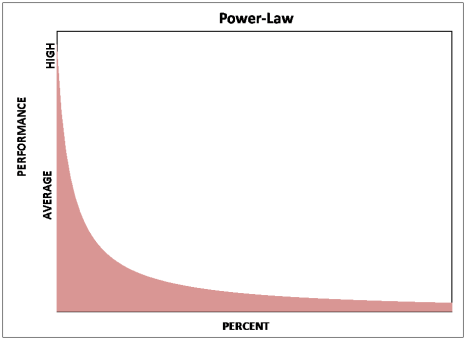
The authors note there is a decades-long consensus that employee performance is distributed on a bell curve.  However, this consensus might be way off base.  Through a series of studies, they show that the distribution of performance more closely resembles a power-law distribution.  Here’s what the two distribution curves look like side-by-side.

image001

image002

The blue diagram should be familiar to most people as “the bell curve.”  There are a bunch of proper names for it, but the features are well-known.  The largest number of people is really close to the peak in the middle, which in this case is the average performance score.  A bunch of people are a little to the left or little to the right of the average, and those are your below-average and above-average performers.  Then there are tails on either side of the curve; those are the rare low and high performers who are often about to get terminated or promoted.

There’s another way to look at it.  The rose-colored diagram is called a “power-law” distribution.  (Note that in this case the axes are reversed so that performance runs up-down and percentage runs left-right).  This diagram can reflect the likelihood that you will buy a rock album, with you and millions of others buying Beatles and Broken Bells on the far left of the curve, and dozen people buying albums from your own band on the far right.  The important thing to notice about the power-law distribution is that there’s a lot of activity on the far-left side of the diagram where the high performers are satisfying customers.

Researchers tested employee performance in a number of fields and found that performance more closely resembles the rose-colored diagram, the power-law distribution.

The research isn’t supposed to turn out that way, according to mainstream thinking.  The authors get into why we assume that performance fits this bell curve, and it’s not flattering to the legacy of social scientists.  Their zinger is that this is a “received doctrine” passed down from one decade to the next.  Yet if you trace the doctrine back to earlier sources, nobody can name that one study where they proved that the bell curve made sense in the first place.  Rather, there is lots of evidence of people fudging their data and throwing out the “outliers” to get their model to fit the doctrine.

The areas of performance that they studied were entertainers, university professors, politicians, and athletes.  There’s a small vulnerability (which they acknowledge) that these industries might not reflect all sectors.  In my opinion these are all star-system fields with a winner-take-all rewards system, and that system isn’t true of all types of work.  But on the upside, they have chosen fields with lots of data, and where our personal perceptions match the data.  We have heard of Sinatra, Einstein, Reagan, and Babe Ruth.  We understand that people just below the top ranking in these fields are barely known.

According to the math, the power-law distribution implies that top performers deliver the goods to a far greater extreme than originally thought.  People who perform at two standard deviations above the mean – a common measure for high performance – would be four times as productive under the bell curve.  Looking at actual performance, which more closely matches the power-law distribution, the correct multiple is seven times as productive.  At the top one-tenth of one percent of performance, the bell curve says they are six times as productive but power-law says they are twenty-five times as productive.

What about people who are below-average?  With the bell curve, the below-average people are one-half of the population because the average cuts the distribution in half.  It’s almost like a democracy.  But because superstars deliver so much more under the power-law distribution, it skews the average and creates a larger pool of people who are below average.  With a power-law distribution, below-average performers are 66% of academics, 83% of actors, 68% of politicians, and 71% of professional basketball players.

This research has many implications.  For example, those who have excelled might want to keep all of the gains for themselves, opening a controversy about the distribution of the spoils.  However the authors flag that excellence does not exist in a vacuum and all of these people are surrounded by support systems that cause them to be great.  Perhaps the gains from high performance need to be re-invested into these support systems to sustain excellence over the long-term.  Some superstars also engage in anti-social behaviours because of fawning admirers and their employer’s reluctance to terminate.  These behaviours make great gossipy television, but it doesn’t look good during lawsuits.  It is also unclear what traits cause these people to be superstars and whether these traits can be developed. Could we choose to create superstars then cast them aside every few years and start again?  Isn’t that what boy bands are all about?

I have worked in a couple of fields with a number of employers, and I have experienced diverse feedback about my own performance.  Let’s give others the benefit of the doubt and assume that the feedback is accurate.  Could it be that each of us is exceptional at one or two things, and mediocre at the rest?  Does it sound about right that we are more exceptional in some environments than others?  There is over a thousand professions on this earth and there are many workplaces.  How do you find that one skill and that one workplace where you rock the world?  …but enough about me and you.

If you work in human resources, how do you help other employees find that one thing?  If you’re in public policy, how do you organize a modern economy so that more people can find that perfect fit?  Would you ear-tag individual employees by type, place them into known jobs, prescribe what they ought to learn, and judge them against the average?  Or would you assess employees for their past moments of magic, foster intrinsic motivation, cultivate them to experience bursts of growth, build the work around their talents, and encourage them migrate into roles that are best for them?  As you can see, core mathematical assumptions have a big impact on how we talk to one another as humans.

Beating Bias with Blindness

Blind Justice. By Tim Green.
Blind Justice.  Photo courtesy of Tim Green.

Managers and human resource professionals are supposed to have non-discriminatory hiring practices.  Yet we are only in the early days of seeing job applicants neutrally.  There are several new (and not-so-new) methods for considering applicants fairly.  There is also the possibility of using good math to prove and reduce bias.

Canada’s federal public service announced on April 20, 2017 that it is starting a pilot project to recruit job applicants on a name-blind basis.  The minister responsible said “research has shown that English-speaking employers are 40 per cent more likely to pick candidates with an English or anglicized name…”  At the end of the pilot they will analyze the two sets of candidate shortlists, both name-blind and traditional-method.  The results of the experiment will be ready in October, for possible roll-out to the entire public service.

What is worth noting is that the Canadian government is running a formal experiment for a limited time.  This raises hope that the eventual course of action will be determined by evidence, not speculation.  They will measure the discrimination before attempting to remedy it, which could bolster support.  The approach also implies the pilot has permission to fail.  After all, they might find something totally different from what they expected.  But that kind of thing that happens when you care about science.

Of course this pilot addresses only one part of the discrimination puzzle.  I would speculate that résumés that still indicate the year and city in which a degree is attained will tip-off employers about age and ethnicity.  An obvious next phase of analysis is to block-out the graduation date and the name of the University.  After all, you only need to know if they finished their degree, plus the degree’s level and academic major, and a broad sense of the school ranking (i.e. top-100, top-400).

Job applications also reveal writing style, which should be good.  But there are differences between the sexes in the use of words.  In the book The Secret Life of Pronouns by James W. Pennebaker the author reveals the findings of high-volume statistical analyses revealing (amongst other things) that men make bold pronouncements without referring to themselves in first-person.  Women, by contrast, attribute their story to themselves, which is more clear, social, and modest.  I personally think that confidence, and willingness to boast, are unreliable indicators of competence.

In classical music, blind auditions are now commonly used to select new hires onto symphony orchestras.  They’ve been doing this for years.  The musicians submit recordings of their auditions and provide live performances behind a physical screen.  I have heard that judges gossip “you can tell” if the candidate is a man yet when the winner steps out from behind the screen it is often a woman.  In this not-so-new paper from 2000, authors Claudio Goldin and Cecilia Rouse conducted an analysis of 7,065 individuals and 588 audition-rounds to see what impact blind auditions had.  They identified that the blind auditions work.

When you’re fighting the man, words are important.  When you’re putting change into effect, math is importanter.

All Tied Up at the Recruiting Rodeo

Los Alamos Rodeo, by Larry Lamsa.jpg
Los Alamos Rodeo.  Courtesy of Larry Lamsa.

Is your workplace having a hard time chasing down suitable talent?  It’s a hard game to play, chasing after that one strong candidate who is ready to stay in place. Employers have had challenges with hard-to-fill positions for some time.  Businesses in North America struggled to fill (and retain staff in) “hot skills” areas since the late nineties.

If someone has the hot skill they disrupt business because they can simply choose to work as a contractor, charging more.  When money is not the issue, skilled workers just decide for themselves the location and conditions of their work.  I once worked in an office that abandoned standard business attire because the Information Technology staff refused to wear ties.

There are skills shortages in parts of India, according to this recent article. In India’s law enforcement sector, there is the perception that government officials are not placing a high priority on filling job vacancies.  This implies a large-scale manager error.  The defence sector notes that people are leaving their sector to work in other parts of the economy where they are treated better. In healthcare, professionals are declining to work in rural areas where there is relatively little infrastructure.  In the education sector, professors are declining to work outside of major cities, so rural and small town job postings stay vacant.

What is noteworthy is that the situation in India persists in a land of 1.2 billion people.  When hiring managers seek out talent to fill vacancies they will often encounter a feast or famine of job applicants.  It’s a double bind.  In a society that struggles with the personal and political turmoil of unemployment and economic hardship, employers must also struggle to find a single qualified applicant.

In this rodeo, employers might think they are the cowboy.  But sometimes they are the calf.

Modern Samurai Wield Swords of Data

Samurai, by Johan Sinso
Samurai.  Courtesy of Johan Sinso.

Data analytics will be regarded as an increasingly important skill for professionals in the modern workplace.  These comments come from Eric Schmidt, executive chairman of Google’s parent company Alphabet, and Jonathan Rosenberg, adviser to Google’s CEO Larry page.  They identify that jobs using analytic skills are expected to grow by 30% over the next seven years.

The executives name some known areas of higher-level skills such as Excel, SQL and Tableau, as well as a grasp of calculus.  However, they also noted that “an understanding of how to approach big data would still be very helpful in finding a job.”  My experience has been that just within Excel a couple of basic cross-tabular tables allow you to pinpoint key findings.  It’s like the high-and-low when you’re creating an outfit or decorating a room.  You need one or two blockbuster items to make things excellent, but other things can be pulled from Ikea or a thrift store.

Eric Schmidt poses the metaphor that “Data is the sword of the 21st century, those who wield it well, the samurai.”

Retail Gets a Knockout Punch

IMG_0110, by Robert Starkweather, edits allowed
IMG_0110, courtesy of Robert Starkweather

Employers are increasingly concerned about whether their current business model is compatible with a fast-changing external market.  With technological change increasing its pace, employers are worried that they don’t have the right staff or technology to adapt to the new economy.

This New York Times article from April 16, 2017 describes a sharp turn of events in the retail sector in the US.  Online shopping is savaging the bricks-and-mortar retail sector.  There has been a gradual, decade-long shift from physical retail outlets to sites like Amazon.  But right now things look more dramatic.

In labour economics there is a key concept that labour demand is a derived demand.  When the demand for certain business outputs increase, the demand for workers who deliver those outputs also increases.  It is not so in this case.  The technology of online shopping gets products into your home while employing fewer workers.  This means that shopping revenues can increase while retail jobs decrease.  From October to the time of the article, 89,000 people had been laid off in the retail sector in the US.  The job losses themselves are larger than total employment in the coal sector.

The article poses the concern that “job losses in retail could have unexpected social and political consequences, as large numbers of low-wage retail employees become economically unhinged, just as manufacturing workers did in recent decades.  About one out of every 10 Americans works in retail.”

This situation raises more questions than it answers.  Will we be able to employ former retail workers in a different part of the economy?  For those businesses that are thriving in the current environment, what will be the onus on them to cover the cost of the downside?  What if you lost your job and went to find temporary work in the retail sector, and discovered you couldn’t even find that kind of work.

Disgruntled workers are already sending mixed signals at election time.  That blowback is arising from two decades of job losses mostly in the manufacturing and resource sectors.  Now the disruption is making its way into more sectors and the change is happening more quickly.

Could it be that the dynamic between technology, globalization, dis-employment, and volatile voting patterns is going to become even more dramatic?

Let’s Just Pretend This is Normal

cocoa #22, by nao-cha
cocoa #22.  Courtesy of nao-cha

It’s important for employers to watch labor market trends because it gives us a glimpse into the workplace culture of the near-future.  Between the rows of statistics we see an emerging screwball comedy which could play out in selection interviews and corporate back-offices.  Following the plot is important for our own careers, but it’s also important for keeping amused.

There are forecasts that the second quarter of 2017 will see a jump in new hires in the US.  This interesting article by Scott Scanlon of Hunt Scanlon Media notes that employers had been waiting-out the hype of a change of US President, and are now choosing to hire more staff.  It’s partially a result of a few quarters of employers standing pat through the election period.

Regardless of whether one agrees with Trump’s policies you have to admit that he is provoking activity.  Whether it’s the sporadic cancellation of plans to relocate plants outside of the US, or the increased activity at law-enforcement agencies, or the growing likelihood a wall will be constructed on the border with Mexico, lots of people are running around doing more work.  Whether the changes are good or sustainable is not relevant to the fact that increased activity creates jobs.  And job growth has a knock-on effect on consumer confidence and housing starts.

Employers anticipate an emerging talent shortage.  However, the employers themselves are partly to blame.  Hiring managers expect to hire the very best people when they open a posting.  Can you think of any solutions?  I have an idea; how about we get rid of perfectionism amongst hiring managers?  After several decades of employers always having the upper hand, organizations might have developed a management culture that is incompatible with job-seekers calling the shots.

Also, employers have been reluctant to hire candidates to grow into a role, or to invest in developing talent.  What ever shall we do?  Change gears by hiring candidates who can grow into a role, and then invest in their talents?  It seems like such a strange thing to do!

There are “job seekers looking for 20-plus [percentage] increases in salary to make up for the lack of raises and increases over the past few years…”  Employers are responding by shifting to an on-demand workforce, referred to elsewhere as the Gig Economy.  But people taking gigs will often charge double or triple the rate of a salaried employee.

Employers can’t handle the humiliation of acknowledging that union representatives and millennials have had totally reasonable expectations all along.  We’re obliging people to triple their wage, come up with a company name for their services, and then skip HR and just talk to supply management about their vendor contract.  Business leaders aren’t in this for the money anymore; they have to maintain composure.

All that’s missing is an economy where all of these contractors collect receipts to reduce the taxes on their business.  So… who’s going to pay for that wall?